
Everybody who walks has probably had the experience of standing on the corner waiting for an opening in traffic to safely cross — and nobody stops. In many cases, drivers probably just don’t notice pedestrians (in some cases, they might not care) because they are focused on getting where they are going and on monitoring a bigger danger, other cars.
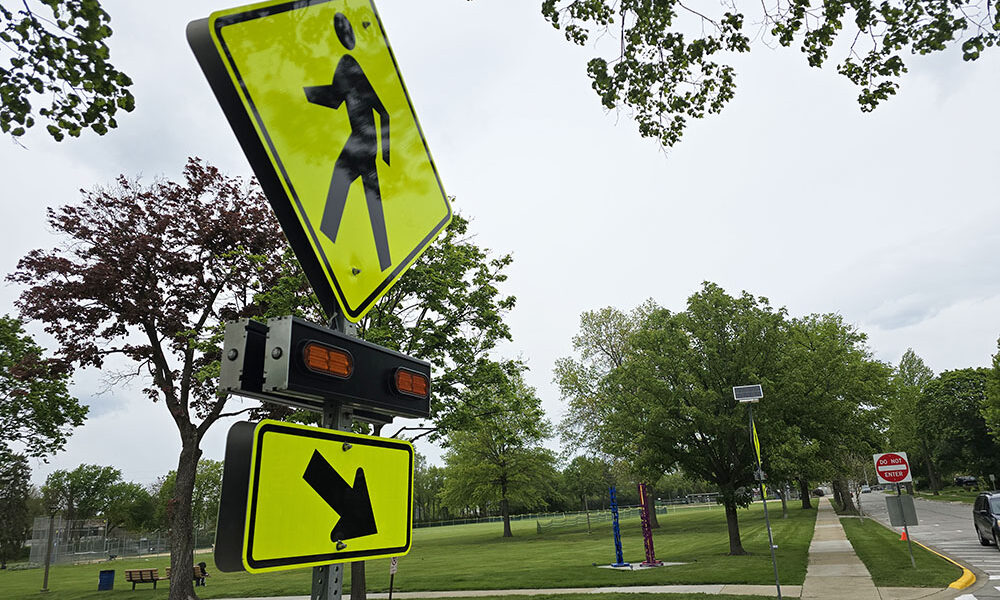
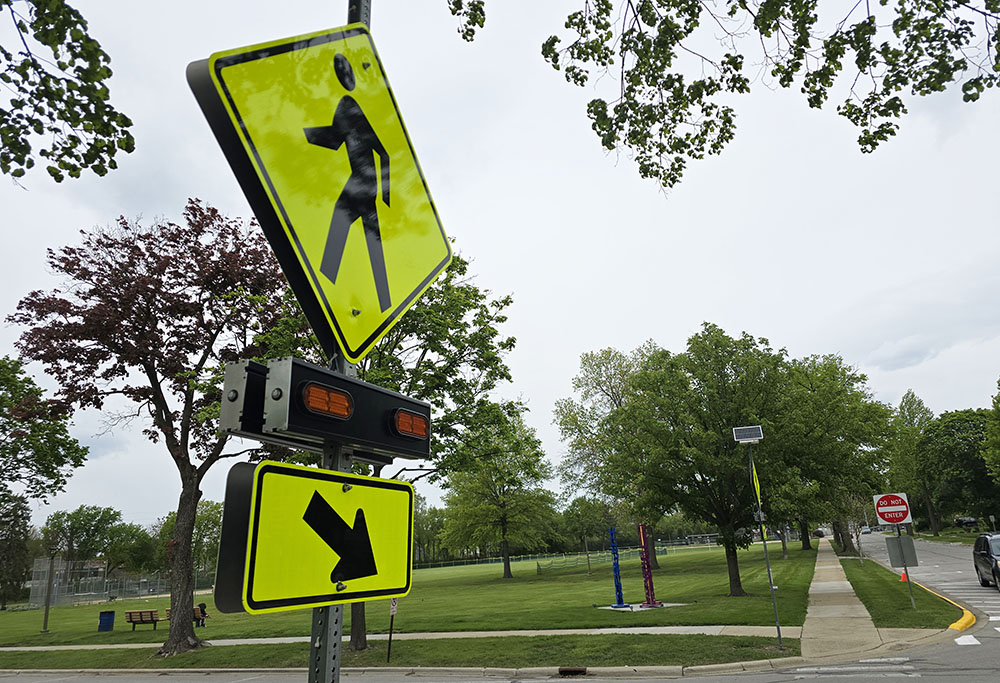
Both Homewood and Flossmoor are bringing help to pedestrians in the form of new crosswalk signs with flashing lights that can be activated by pedestrians.
Flossmoor recently installed pairs of pedestrian crossing signs at School Street and Park Drive just east of Parker Junior High, at Flossmoor Road and Braeburn Avenue and at Flossmoor Road and Brassie Avenue near Flossmoor Park and Western Avenue School.
Homewood has plans to install similar signs at a number of downtown crosswalks in a three-phase project. The first phase work should start soon and will improve four crosswalks: Harwood Avenue and Ridge Road, Ridge Road and Martin Avenue, Chestnut Road and Harwood Avenue and Dixie Highway and Chestnut Road.
That last one will be a test. Dixie is difficult for pedestrians to cross at Chestnut much of the time. There’s often a steady stream of traffic that offers few breaks long enough to scurry across.
After the proposed residential building is finished on the current village hall parking lot, more people will be parking on the east side of Dixie, through an agreement with St. John Neumann Church, and will need a safe way to get to village services and businesses on the west side.
If the improved markings and lighted sign can make that crosswalk work better for pedestrians, it will be a big win for safe mobility downtown.
A contract for engineering and design work for the second phase was approved by the Board of Trustees on April 14. Phase 2 will improve two crosswalks on Dixie Highway, one at Hickory Road and one at Olive Road, and three crosswalks on Ridge Road: at Gottschalk Avenue, Highland Avenue and Gladville Avenue.
The villages are using similar tech for somewhat different purposes.
The proximity of Flossmoor’s new flashing signs to schools suggests safe travels by students on foot is the primary focus.
In Homewood, the crosswalk improvements are in and near the downtown area, so safety for pedestrians working or shopping in the central business district appears to be the main purpose.
Those improvements could have a small but significant additional effect of reducing traffic on busy streets feeding into the downtown area.
It’s a case of induced demand.
When pedestrians feel safer, they are more likely to walk. Every person who walks downtown instead of driving is one less car on the road, one less parking spot used.
Roughly 11,000 people live within a one-mile radius of the intersection of Dixie Highway and Ridge Road. They are the mostly likely candidates for converting some trips downtown from car to walking (or biking). What percentage of them actually make walk/bike trips is hard to estimate, but the potential is there to reduce traffic and ease parking problems by increasing crosswalk safety.
Stop (some) speeders with tech
From conversations online and in person over the years, I’ve formed the impression that people in Homewood and Flossmoor are not fond of the behavior some motorists exhibit, especially speeding.
People often express frustration that state law does not allow our villages to use speed cameras (Chicago is the only municipality that can). But the state might provide another mechanism aimed at slowing speeders down.
HB4948 is working its way through the state legislature now. It passed the House on April 16. Representatives from our area voted for it, including Will Davis, Anthony DeLuca, Debbie Meyers Martin and Thaddeus Jones.
If the law passes, it would enable the state to offer an option to chronic speeders, defined as drivers who are guilty of exceeding the posted speed limit by 26 mph or more at least two times in 12 months. Instead of a driver‘s license suspension, the law would allow speeders to sign up to have a device installed on their vehicle that would limit their ability to exceed the speed limit.
According to the Active Transportation Alliance, which supports the bill, “almost half of traffic fatalities in Illinois involve speeding and studies show a small group of repeat speeders are up to five times more likely to be involved in a serious or fatal crash.”
The program would not solve all speeding problems, but it could temporarily restrain some of the worst bad drivers.
Axios Chicago reported on April 24 that another solution to speeding might be on the horizon. The state is weighing a driverless car pilot project. Justin Kaufmann, Carrie Shepherd and Monica Eng quote San Francisco reporter Nadia Lopez, who observes that Waymo autonomous cars “drive like grandmas.”
Good.
The story also quotes Waymo spokesman Ethan Teicher, who said, “Waymo vehicles are designed to follow the speed limit. That may seem ‘too slow’ given the status quo, but research shows speed compliance significantly reduces serious injury in the event of a collision.”
I can’t say I’m eager to get in a driverless car, but this notion of having vehicles that are designed to follow traffic laws sounds attractive. Humans certainly struggle with the concept.
E-bike law
Flossmoor passed its own e-bike ordinance earlier this year. Homewood has not followed suit yet. Village officials said they were waiting to see Flossmoor’s rules so the village could craft something compatible.
The state might take care of the alignment challenge.
A bill that appears to have a chance for passage this session is SB3336, the micromobility bill supported by Secretary of State Alexi Giannoulias. It would strengthen state law governing e-bikes, e-scooters and e-motos. In an April 15 press release, Giannoulias lauded the state Senate’s unanimous passage of the bill.
“As these devices become faster, heavier and more powerful, our laws must keep pace to protect riders and the public,” Giannoulias said. “This initiative closes dangerous regulatory gaps, creates uniformity across Illinois communities and ensures riders understand the responsibilities that come with high-speed electric devices. We’re replacing a confusing patchwork of local rules with clear statewide standards that prioritize safety.”
Setting rules for use of e-vehicles is urgent. Locally, there were two reports in just the past week or two about incidents that could have ended in tragedy. One person reported her child’s e-bike was hit by a car driven by an apparently inattentive driver. Fortunately, the rider was shaken up but uninjured.
Another report described e-vehicle riders zipping through red lights and having close calls with cars. Riders have to do their part to stay safe, and dodging around bigger, faster vehicles that can crush you like a bug is not best practice.
In Chicago, there have been three recent deaths of e-vehicle riders. We need better laws, more education (and helmets!) before something like that happens here.
I don’t use an e-bike myself, but I’m in favor of regulations that help promote their use by improving safety. Micromobility machines help people get around town with much smaller environmental impact than cars. E-vehicles take up less space (another help with parking problems). More e-bikes can mean fewer cars, so the spread of micromobility helps drivers by reducing the number of cars they have to compete with for road space.
Next, we have to address micromobility infrastructure, but that’s a bigger, more expensive task.