

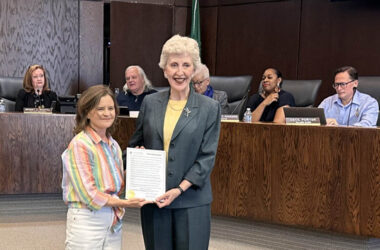
The Heather Hill Civic Association discussed community safety on May 14 with Flossmoor Police Chief Carl Estelle and Les Rodgers, a member of the Ballantrae Neighborhood Watch.
Estelle spoke to the meeting attendees about current work in the department and ways the community can support the police in their endeavors and introduced a few of the officers for residents to become familiar with.
He spoke about how the police cannot do their jobs without the help of the community.
“We’re not asking you to go out and get involved and intervene, but if you see something, say something,” Estelle said. “That’s really one of the few things that keeps our neighborhoods, our village of Flossmoor as safe as it is.”
He said the new camera systems and license plate readers have helped the police identify individuals for ongoing investigations in town.
The main things discussed during question time were cars speeding through the Heather Hill neighborhood and possible solutions such as speed bumps and recruiting more officers.
After having a moment for local businesses to speak, Les Rodgers from the Ballantrae Neighborhood Watch gave a presentation on the topic of neighborhood watches, their importance, and where to start making one.
He gave brief background on his service being a homicide detective for 18 years, and a juvenile officer for the Sheriff’s department with a 30-year-long career in law enforcement which drives his love for his community, Rodgers said.
Rodgers said since starting the watch group they’ve worked closely with Flossmoor Police Department communicating concerns and finding out what the community can do to solve them.
“You don’t need the permission from the police department. You don’t need permission from the Homeowners Association,” Rodgers said. “It is the volunteers in your community that say we want to get ahead of what’s going on in our community.”
Rodgers gave a brief history of the neighborhood watch in America, with it becoming a national program in 1972 under The National Sheriff’s Association.
According to The Journalist’s Resource, citizen policing programs have been connected to the decrease in crime by 16% in communities with Neighborhood Watch groups.
He provided the attendees with a digital manual to start with if they plan to pursue a neighborhood watch in the future.
The manual includes five steps to building a successful neighborhood watch which include recruiting, contacting local law enforcement agencies, meeting, discussing community concerns to take action on, hosting regular meetings, and implementing a phone tree.
He made sure to make a disclaimer on what a community watch cannot do having dealt with previous instances where people might have overstepped their part.
“We are trained observers, okay. We report what we see and hear,” Rodgers said. “We do not get involved in police business.”
As Rodgers presented, he talked in depth about each step to making the neighborhood watch in detail, how they went about it in Ballantrae, and took questions after.
Questions ranged from how long the Ballantrae group has been around to how they run things in their neighborhood.
Rodgers said a watch group can drastically change a community in terms of becoming more cohesive and maintaining better neighbor relationships.
“I hope that you all will come together… the only thing you need to do is get the training to make sure that you don’t have liability because this is a group of people who are just the eyes and the ears,” Rodgers said.
Heather Hill Civic Association President Ashly Giddens said the conversation of starting a neighborhood watch will continue at the organization’s June 11 meeting.