



Editor’s note: This story is an updated version of one that ran on May 18. This version includes more information.
Concerns about the water quality of ponds in the Izaak Walton Preserve are being addressed, but the assessment isn’t likely before the end of the year.
The Homewood Village Board agreed May 13 to hire Fehr Graham Engineering & Environmental to conduct a water quality study for the Prairie Lakes Stormwater Detention Facility, a series of ponds on the west side of Izaak Walton Preserve.
The consultant’s timetable is to test the ponds’ water at three distinct times over the next six months.
Matt Dobrik, project manager for Fehr Graham’s Aurora office, presented the board with an overview of the firm’s work in Kane, Kendall and DuPage Counties with government bodies and private institutions dealing with water quality and sediment settling, landscape design and rehabilitation of wetlands.
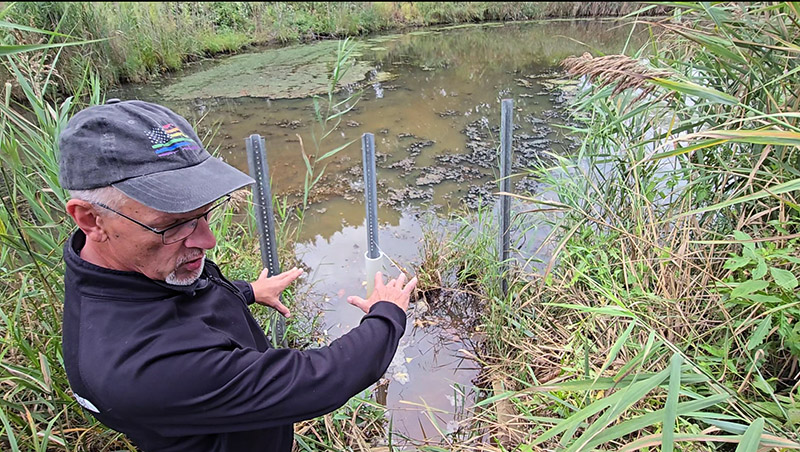
The firm’s work for Homewood will include water quality testing, monitoring and analysis of pond water and a sediment depths survey.
The timetable is for three rounds of sampling. Within the next month or so, the company wants to test spring flows when upcoming heavy rain is expected. Testing in summer will be during drier conditions, and then a final winter sampling, Dobrik said.
The firm’s last assessment will likely be “in December because we want to capture winter flows with the stormwater detention facility.” A winter sampling will give the consultant “runoff from outflows and salting roads and the changes that occur in wintertime,” Dobrik said.
The village will get a progress report in August after a couple rounds of water sampling and one round of sediment sampling has been done. The final analysis would be delivered in late December after Fehr Graham has gotten all the lab results and subcontractor reports. Dobrik’s final analysis will give an “overall environmental health and quality” of Prairie Lakes.
The village board approved an $80,000 contract with Fehr Graham. The Izaak Walton board agreed to pay $7,500 of that cost.
Village staff and representatives of Izaak Walton interviewed two firms for this project. Fehr Graham was selected “because of its understanding of the scope of work, depth of expertise across relevant disciplines and closer proximity to Homewood,” Terence Acquah, assistant village manager, told the board.
Environmental activists raised the alarm about the water quality in one of the ponds in August 2024 arguing there could be any number of causes for the water at one site to appear orange. They charged the village had not faithfully monitored the water system in the preserve and believed that the source of the brackish water could be discharge from a local business.
Activist Liz Varmecky, founder of South Suburbs for Greenspace, has addressed the board about the situation a number of times since then, most recently on April 8, when she chided village officials for not moving with enough urgency to study and solve the problem.
She noted that the Izaak Walton board first asked the village to conduct testing on the northwest pond in September 2021.
“That’s three years before any testing was performed,” she said. “If the village has been working in lockstep with the Izaak Walton board, it is only after South Suburbs for Greenspace got involved, after the media’s involvement. The village’s cooperation is the result of community pressure, activism and bad publicity. This is what it takes to get the village to respond to residents.”
According to Acquah, the village and Izaak Walton Preserve both contributed to the preliminary water quality study conducted by Bryan Environmental Consultants, Inc. of Homewood in November 2023. The results of the study showed harmful hydrocarbons in the water, but the risk posed by the substances was up for debate.
The village consulted with the Illinois Environmental Protection Agency. After the IEPA staff analysis, no toxicity was reported, according to Napoleon Haney, village manager, but the village does want to try and get answers to the concerns that have been raised.
A 1977 racetrack fire is suspected to be the cause of fluoranthene being present, which is a common byproduct of burned materials. This will be evaluated in the analysis by Fehr Graham, Acquah said.