

Martin Luther King Jr.’s holiday has passed, and we are heading into Black History Month, making this a good moment to reflect on both.
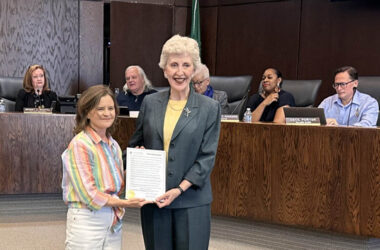
As usual, Flossmoor knocked it out of the park with its 10th annual MLK Day of Service event, which coordinates dozens of service projects in the village and surrounding communities.
At the Jan. 22 village board meeting, Village Manager Bridget Wachtel noted how far the event had come.
“I think back to 10 years ago, the first year we did it, we had three small projects. I think we were all tucked back in our homes by 11 a.m.,” she said. “To have watched this blossom into record-setting projects year after year, it’s a proud moment for the community. Flossmoor prides itself on volunteerism all year long and not just on that day.”
One of the records broken this year was single-day Lego set collection for Bricks of Hope. Village Clerk Gina LoGalbo reported at the board meeting that she received 150 sets, breaking the organization’s record.

I’m always impressed by volunteers’ cheerful disregard for the sometimes brutal January weather on MLK Day. Last year and this year, the temperature barely surpassed zero. It took until mid-morning on Jan. 20 for the wind chill to reach -18 degrees. Yet the projects I visited were packed with people coming out to help.
As Flossmoor Community Relations Commission co-chair Jackie Riffice noted in a comment to the Board of Trustees on Jan. 6 that the project is the village’s attempt to answer one of King’s oft-quoted questions:
“Life’s most persistent and urgent question is ‘What are you doing for others?'”
The quote is from a sermon King delivered versions of at various times in his life — including once in Chicago in 1967 — called “Three Dimensions of a Complete Life.”
A partial transcript I found of the Chicago version, which didn’t include the famous quote verbatim, describes the three dimensions as length, breadth and height.
Length is achieving self-acceptance and fulfilling a purpose. Breadth is about serving others — that’s where the famous quote lands —and height is about trusting in God.
Although self-acceptance and self-love are important, King offers a caution.
“A lot of people never get beyond the first dimension of life. They use other people as mere steps by which they can climb to their goals and their ambitions. These people don’t work out well in life. … You shall reap what you sow. God has structured the universe that way.”
He uses the parable of the good Samaritan to illustrate the breadth of life. A man was injured by thieves and left lying on the road. A priest and a Levite each passed him by, but a Samaritan stopped to help.
“The first question that the Levite asked was, ‘If I stop to help this man, what will happen to me?’ But the good Samaritan came by and he reversed the question. Not ‘What will happen to me if I stop to help this man?’ but ‘What will happen to this man if I do not stop to help him?’ This was why that man was good and great. He was great because he was willing to take a risk for humanity. And don’t forget in doing something for others that you have what you have because of others. Don’t forget that. We are tied together in life and in the world.” (See projects.seattletimes.com/mlk/words-life.html for more.)
We are all tied together, and Flossmoor renews that connection, not just on MLK Day of Service, but often.
Anti-racism library
King’s three dimensions are a prescription for individuals to follow, but as we begin to mark Black History Month, it’s worth taking a look at the dimensions of a good society.
For a disturbing, insightful guide on the reason American society continues to struggle with racism, I would suggest putting Ava DuVernay’s film “Origin” on your Black History Month watch list.
The film is based on “Caste: The Origins of Our Discontent,” by Isabelle Wilkerson. It dramatizes Wilkerson’s life while researching the book. Aunjanue Ellis-Taylor stars as Wilkerson. (Origin is streaming on Hulu and other services.)
The film breathes a new life into the ideas from “Caste” because Wilkerson, as the lead character, shows us how she discovers the parallels between two infamously inhuman caste systems, in India and in Nazi Germany, and the American caste system (from which the Nazis took inspiration).
The film provides less detail but much more compelling images (as film does) than the book.
Reading about two Black scholars witnessing a Nazi book burning and watching as they witness the flames are very different experiences.
Reading about the degradations of the Dalit people in India is one thing, watching a scene where a Dalit has to immerse himself in human waste to clean a public toilet is quite another.
She also refers to MLK’s visit to India in 1959 and his shock at being introduced as a fellow “untouchable” (or Dalit) by a school principal. As he thought about it, though, he realized the term was appropriate. In the book, Wilkerson says King realized that caste was “what lay beneath the forces he was fighting in America.”
That’s Wilkerson’s central thesis. As she puts it in the book, “Caste is the bones, race is the skin. … Race is what we can see … caste is the powerful infrastructure that holds each group in its place.”
If you’ve ever wondered why American culture clings so tenaciously to its racial hierarchy, “Caste” and “Origin” provide illumination.