

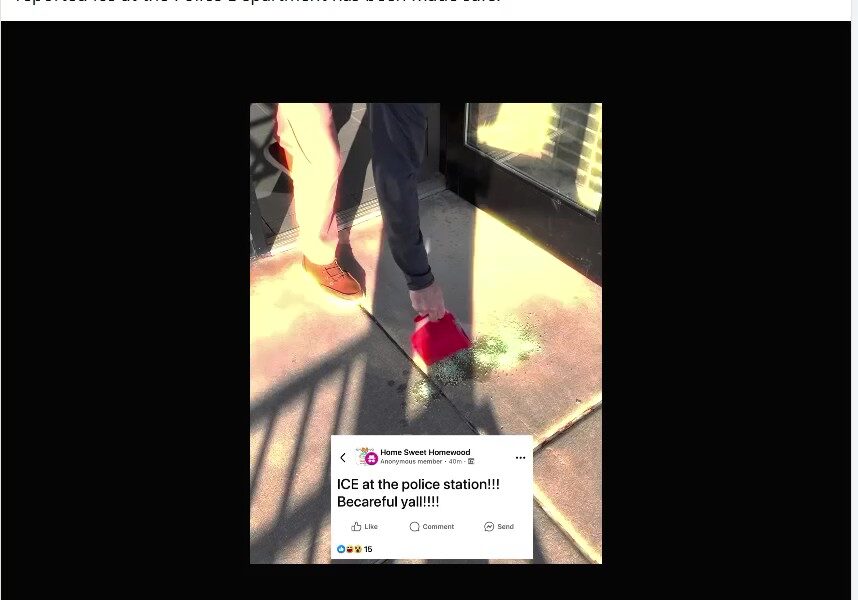

A screen capture of an eight-second video posted by Homewood police on Dec. 19.
Opinion

Commentary: Humor misfire leads to learning opportunity

Humor is risky business. Sometimes jokes launch laughter. Sometimes they land with a thud. Sometimes both. The Homewood Police Department tried a little humor on Friday, Dec. 19, with a brief video posted on social media that was intended to lighten the mood after recent immigration enforcement activity in the region. 

It got a mixed response, initially landing with a thud, then getting some enthusiastic appreciation. Department leadership apologized to those who were offended, and the incident seemed to blow over quickly. 

I bring the situation back up because I think it offers a great opportunity to learn about blind spots and what to do about them.

A screen capture of an eight-second video posted by Homewood police on Dec. 19.
A screen capture of an eight-second video posted by Homewood police
on Dec. 19.

The video had a caption that said, “The Homewood Police Department wants everyone to know that your safety is our #1 priority. The reported ice at the Police Department has been made safe.” 

The video started with a screenshot of an anonymous social media post that read, “ICE at the police station!!! Becareful yall!!!!” Above the screenshot is video showing a person who’s face is not visible but appears to be white spreading what appears to be salt on a small patch of ice on the pavement.

The comments started coming in within minutes. Some were supportive, but some were from people who were deeply offended. 

One woman said she had been a resident for 10 years but had recently started carrying her passport with her to prove her citizenship “in case I am picked up with no cause other than my skin color.”

Operation Midway Blitz, which started in September in Chicago, and now in Operation Metro Surge in Minnesota have demonstrated that immigration status is not the primary determinant for people to be violently detained. It’s race. 

The agents involved in the crackdown have tackled people, hauled them out of vehicles, indiscriminately tear-gassed neighborhoods, sprayed chemicals into people’s faces, separated children from parents and shot peaceful protesters with less-lethal projectiles. They consistently have targeted people with brown skin, even those who have documents, are in the process of obtaining documents or are U.S. citizens. 

Agents have even detained a number of Indigenous people. It’s hard to imagine anyone less of an undocumented immigrant than a tribal citizen.

People accosted by ICE have been shot and killed. Dozens have died in custody. 

The violence and racial profiling have terrorized people, and while there have been few reports of ICE or CBP activity in the South Suburbs, there is no reason to believe our region is in any way exempt. People have reason to be afraid, especially people with brown skin or Hispanic names. 

Another problem with the joke is that the main character appeared to be a white male police officer. That’s a safe position, someone very unlikely to be targeted by ICE. The joke was perceived by a number of residents as an attempt to diminish or dismiss their very real fear of ICE. As one commenter put it: “Laughing at your communities concerns only clarifies that you are not here to serve or protect.”

To the credit of village officials and Homewood Police Department’s leadership, the video was deleted shortly after it was posted, and on the department’s Facebook page, an apology was added.

“A recent Facebook post was intended to be lighthearted but missed the mark. We sincerely apologize to our community and followers.  We are committed to doing better and being better.”

The apology got many times more comments than the original joke, and the comments were overwhelmingly in support of the joke. 

The common sentiment was that people who complained about the joke were being too sensitive and should relax and get a sense of humor.

“Funny, yes. Insensitive? Also yes,” one commenter said.

Another commenter got to the heart of the matter.

“I totally get the intention to try and lighten the mood with humor, but thank you for the apology! It takes a lot of character to own up to your fumbles. And yeah the ‘no one can take a joke nowadays’ crowd probably loved it cuz they have no connection to the trauma and danger. It’s easy not to flinch when you’re not the one being punched.”

I do not assume anyone in HPD who was involved in creating the video meant to cause any harm or intended to offend anyone. Based on my interactions with officers and leaders, HPD is a professional team dedicated to serving our community.

I’ve been in similar situations, saying something I thought would be funny and learning the hard way that it was not, so I get it. Those uncomfortable moments are opportunities to unearth a blind spot and treat the thing with some education.

The apology was appropriate and well received. It’s a first step, though, not the last, in turning an unfortunate mistake into a conversation that could prove to be a great asset to the department and the community.

There’s a whole subgenre of antiracism literature that addresses how white people (especially) can learn from situations like this, avoiding defensiveness in order to make real progress during what is almost always a difficult experience.

One good guide is “Me and White Supremacy: Combat Racism, Change the World, and Become a Good Ancestor” by Layla F. Saad.

“While call outs and calls in never feel good, they are an invitation to become aware of behaviors and beliefs that are hidden to you, and they are an opportunity to do better so you can stop doing harm and make amends for the pain caused.”

Another good resource is “Blindspot: Hidden Biases of Good People” by Mahzarin R. Banaji and Anthony G. Greenwald. Their research helps readers understand how implicit biases operate, how pervasive and tenacious they are and how to recognize them.

The hidden nature of our biases is what makes them difficult to deal with. We don’t even know they are there, so when they emerge unbidden, we tend to feel unfairly disparaged if someone points them out. 

One barrier to get past is the assumption that intent confers absolution. I wish it did, but it doesn’t. When we cause harm, we should make amends.

The first step to making amends is to grab that blind spot when it becomes visible and wrestle it all the way into the light. Look at it. Learn from it. Listen to the people who were harmed by it.

I had a good talk Saturday, Jan. 3, with Village Manager Napoleon Haney. Ramping up engagement between village staff and residents has been one of his top missions, and he is concerned that pushback like the joke received could dampen enthusiasm for engagement. He said staff talks about social issues and the challenges of increasing interaction. Those conversations will help staff work through the takeaways of the ICE joke incident.

Homewood has made great strides in creating programs that make village government more transparent and welcoming to the community. The Citizens Civic Academy is going into its third year. The Hot Topics forum got off to a good start this fall. The Community Emergency Response Team training was slated to begin Jan. 26. Social media posts have been frequent and alternate between practical information and whimsy. 

All that interaction is good for local democracy, which thrives when barriers between government and residents are made permeable. There are bound to be problems along the way. The lesson I hope staff members take from the community response to the ICE joke is not from the people who laughed but from the people who didn’t. People who laugh at others’ pain are not the role models we want our police officers to follow.

Former Police Chief Denise McGrath, before she retired on Jan. 9, responded to the situation. 

“I think the important thing is we owned it. It’s the same thing I would expect from anybody who makes a bad choice. Acknowledge that it was a bad choice,” she said. The next step, she said, was to ask, “What do I learn from it?”

She was on the right track. But the next question is how does the department and the community learn from this situation? 

I think conversation would help. Social media posts do not adequately convey the perspective of vulnerable people the way a face to face discussion would. A few people, residents and officers, sitting around a table sharing their views might shed light on the how the joke went bad.

Advertisement
Popular stories < 7 days

Newsletter

Meet the Candidates: U.S. Senate

Conversations with the Chronicle