


The Homewood Village Board presented an update for mitigation strategies to address the safety concerns of 183rd Street at the Nov. 11 meeting.
After the ongoing debate of whether or not to implement a road diet, which would reduce the lanes of 183rd Street from four to two with a center turn lane and bike lanes in each direction, the majority of the board voted to go forward with other enforcement mitigation strategies instead of the road diet at the Oct. 14 meeting. Trustee Jay Heiferman voted for the road diet.
According to Homewood Village Manager Napoleon Haney, staff has evaluated the 47 mitigation strategies that were suggested as a result of the study that was conducted by engineering firm Burns & McDonnell. Staff chose the strategies that they thought would be most effective to eliminate accidents and crashes. They narrowed it down to two of which will definitely be implemented, and three that are in consideration, he said.
The two strategies that will be enacted are:
- Installing a traffic light at Center Avenue.
- Converting the “no right on red with pedestrians present” sign to say “no turn on red” on Riegel Road.
According to Haney, the other three strategies they are leaning towards are:
- Installing delineators or medians to prevent left turns at key locations, such as through Dixie to Riegel.
- Lengthening east and west bound left-turn lane on 183rd at Riegel.
- Lengthening left-turn lanes in east and west bound direction on 183rd at Dixie Highway.
There have been nearly 1,000 speed citations on 183rd Street alone this year from January to October, he said.
“Our enforcement is just getting started,” Haney said.
Homewood Chief of Police Denise McGrath addressed the board with the upcoming targeted enforcement plans.
According to McGrath, the first enforcement plan covers a period over eight major holidays and runs through Sept. 30. This round of enforcement efforts is funded with a $70,950 Illinois Department of Transportation (IDOT) grant. The police department said the grant started Oct. 1, 2025. When the IDOT-funded holiday campaigns are not active, the police department will carry out its own internal traffic enforcement plan.
According to Noah Schumerth, Homewood assistant economic & community development director, the goal is to reduce rear-end accidents, which are the majority type of accidents that occur, by extending the left turn lanes.
Delineators would be placed at main accident hot-spots such as Gottschalk due to it being an off-set intersection, Schumerth said. The delineators can be monitored using a software called Urban SDK once installed to see if they’re effective, Haney said.
The village has funding in the capital budget to complete Phase 1, which will be the studies that IDOT will require for the traffic light at Center Avenue. Phase 2 will be design, followed by Phase 3 which is construction, Haney said.
To address child safety, especially in school zones, the village will update and improve signage with high reflectivity and flashes to signal drivers to slow down, Homewood Public Works Director Joshua Burman said.
The narrow sidewalks along 183rd Street also remain a concern.
“For us to widen sidewalks, to do any type of mitigation to the sidewalks, we would have to acquire private property,” Haney said, adding, “so we’re limited.”
One of the few improvements that can be done is placing signage along the sidewalks to improve safety when crossing the street, Burman said.
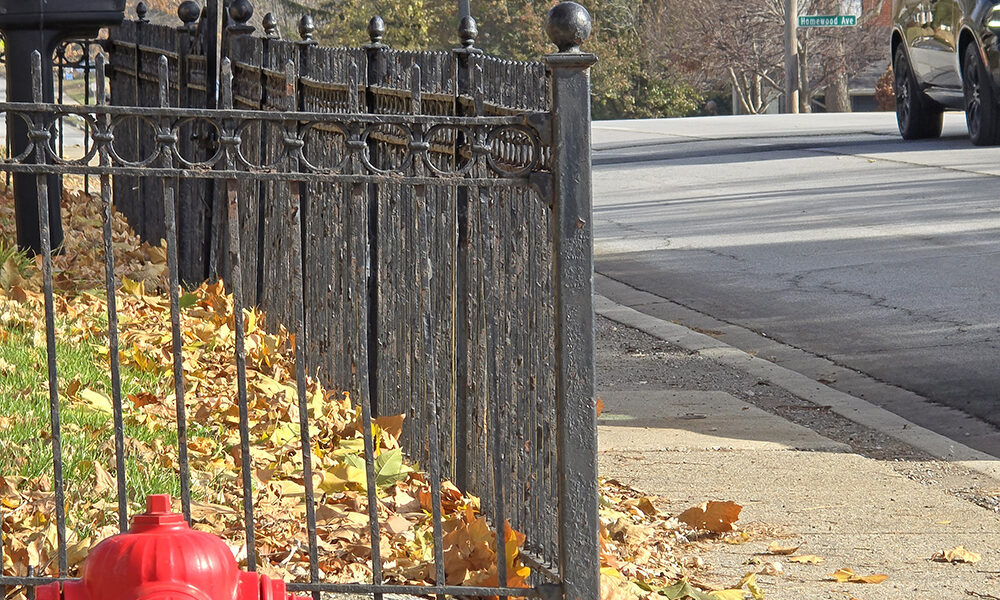
In addition to the sidewalks, the obstruction caused by a fence on Gottschalk on 183rd Street had been a long-time concern for residents of the village, which was also addressed during the meeting.

with 183rd Street partially obscures the view of drivers heading
south on Gottschalk. (Eric Crump/H-F Chronicle)
“We’ve been looking at that, it’s not a simple solution. That fence has been there for years. I know that the village has reached out to the property owner in the past and asked about the possibility of removing or relocating that fence. To date, we haven’t had that luck,” Homewood Village Attorney Chris Cummings said.
The village hopes to receive cooperation from the property owner. If that fails, then the village will take the case to court as a public safety issue, which will require data, Cummings said.
“I believe that the homeowner is confused, needs to be approached properly with plans in hand what we will do for them if the fence is removed– meaning we would take on the landscaping, we would take on the construction, we would leave them with a better home,” Heiferman said.
The safety improvements and mitigations are expected to be complete in spring of 2026.


