


Words matter, and even accurate terms, if they conjure the wrong connotations, are not the best fit. Take “road diet,” for example.
I’ve been advocating for Homewood to prioritize its plan to convert 183rd Street east of Dixie Highway from four lanes to three (two travel lanes, a turn lane plus two bike lanes). “Road diet” is a common term to describe the 4 to 3 reconfiguration.
However, “diet” is often associated with denial. When we diet to lose weight, we’re giving up foods or quantities of food that we enjoy, so diet is associated with denial. Even people who practice dieting often do not like it.

The same appears to be true for lane reconfigurations. People often complain about speeding and other risky driving behaviors on 183rd Street. But a solution to those problems that involves “dieting” (as in lanes, not food), produces some resistance.
From conversations I’ve had online and in person, I think some people are assuming the change will result in something unpleasant and inconvenient. In practice it’s more like switching to a healthy treat that tastes great and doesn’t add pounds around the middle.
But enough of the diet analogy. I vote we retire it.
The evidence available from more than 45 years of similar reconfigurations (the first 4 to 3 lane conversion was done in 1979 in Montana), shows the change almost always results in safer streets, good traffic capacity and improved access. That means 4 to 3 works well for everybody: drivers, walkers, bikers and others.
The Federal Highway Administration notes that studies show 19% to 47% reduction in crashes following 4 to 3 reconfigurations.
The improved safety is the result of decreased speed differentials (most vehicles are traveling at closer to the same speed), fewer lane changes (turn lanes allow left-turning vehicles to get out of the travel lanes) and fewer conflict zones (those are situations created by road design that are opportunities for collisions). Traffic goes a bit slower (that’s the point) but it flows well.
In some cases, capacity increases after a reconfiguration because the flow is more consistent and efficient.
Traffic calming is another common term, but it is more of an umbrella term to describe a wide range of measures that can improve safety in a wide variety of situations.
So I suggest we replace road diet with “community mobility corridor,” or comoco. It’s unwieldy. It’s got a goofy abbreviation. It’s perfect.
Here’s why I like it.
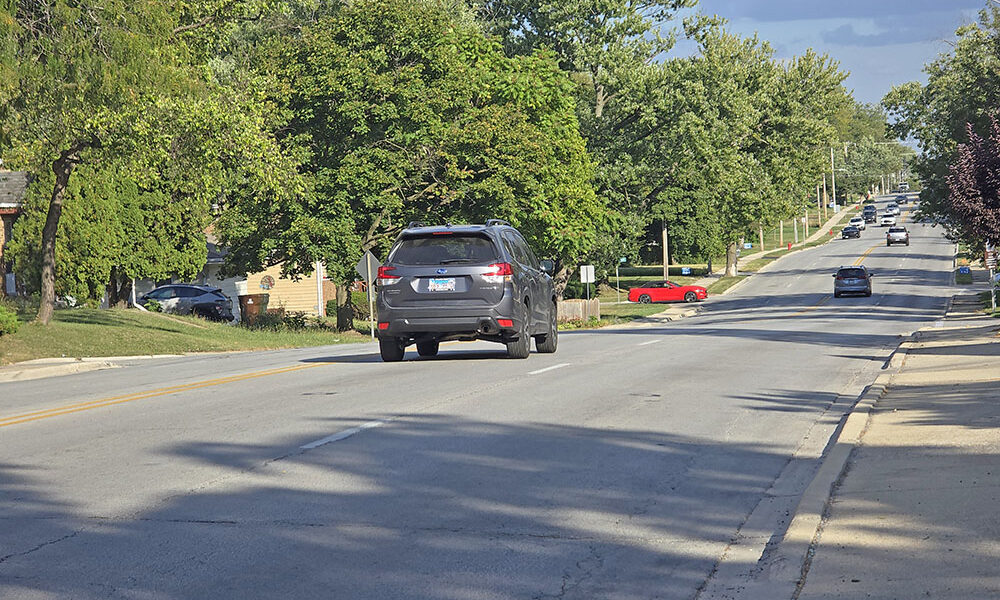
“Community” reminds people that our public thoroughfares are paid for and used by everyone, not just drivers of motor vehicles. Right now, 183rd Street is vehicle-dominated. It was designed so. Lanes are wide and inviting for cars and trucks, but crossing four lanes as a pedestrian is dangerous. There are only three places where crossing is marked and safe in the 1.6 miles between Dixie Highway and Halsted Street. That’s an indication that pedestrians were not a primary concern when the street was designed.
Pedestrians and cyclists also find it challenging to travel along 183rd Street. They have to share narrow sidewalks because it’s not safe to bike on the street. The sidewalks have inconsistent surfaces, obstructions and for long stretches have no buffer from traffic.
That’s why pedestrians and cyclists are rarely seen on 183rd Street. It’s hostile territory.
“Mobility” reminds us that the purpose of 183rd Street is to help people move. Cars and trucks and buses are important tools for mobility, but so are bikes and strollers and scooters and skateboards and wheelchairs and legs.
We have many ways to move, and our public ways can and should support them all. Lane reconfigurations help by enabling cyclists and scooters to leave the sidewalks to pedestrians while also offering a buffer between traffic on wheels and traffic on legs. Everybody’s safer. Everybody can move.
“Corridor” indicates a passageway that links spaces within a larger structure. In this case, 183rd as reconfigured could be a more effective link between parts of Homewood.
As designed, its function as a community passageway is eroded by its function as a regional arterial throughway. It carries a lot of traffic that is not trying to move around Homewood or visit Homewood but just get through Homewood as fast as possible. In a way, Homewood is just in the way of many 183rd Street drivers.
That throughway function has made 183rd Street into a kind of barrier that splits the village into two sections.
I was struck by a comment from a resident that was featured in the Downtown Transit Oriented Development Plan adopted by the village last year. “I ride my bike to Flossmoor station to avoid crossing 183rd and Harwood.” This is a Homewood resident who doesn’t use Homewood’s train station because of 183rd Street.
When I read that, I realized that South Homewood is geographically better linked to Flossmoor than to North Homewood. If you travel from Homewood to Flossmoor on Dixie Highway, Harwood/Western or Western/Sterling it’s not obvious when you’ve left one village and entered the other. The two are seamlessly connected. To go from South Homewood to North Homewood, however, involves crossing busy 183rd Street, which can be challenging whether you’re in a car or a bike or on foot. The street is a permeable barrier. You can get through it, but it offers resistance.
A similar situation exists with the section of town north of 183rd and west of the railroad tracks. That’s why improvements to both viaducts were included as recommendeations in the downtown plan.
The widening of 183rd Street was designed and completed during a time when planners and elected officials were convinced economic growth and traffic capacity were inextricably linked. They weren’t wrong.
But they also had a certain myopia about what kind of transportation technology to consider in their plans. They apparently thought mobility = motor vehicles. The old newspaper stories I’ve read make little or no mention of how pedestrians, cyclists and people with disabilities would use 183rd Street. Those travelers just weren’t on the radar.
The Americans with Disabilities Act was passed in 1990. It made inclusion the law of the land, and it should be the guiding spirit for shaping our public ways.
I realize “comoco” is a ridiculous replacement for road diet, but maybe somebody will read this, snort derisively, and propose a more elegant term. Just so it also conveys the idea of making major streets a resource everyone can use safely and conveniently, converting them from barriers to seams that knit the community together and still serve regional tranportation needs.
The Homewood Board of Trustees is expected to be briefed by staff on the status of the 183rd Street project at the regular board meeting, 7 p.m. on Tuesday, Oct. 14, in village hall, 2020 Chestnut Road. That will be a good opportunity to learn more and express your views.


