
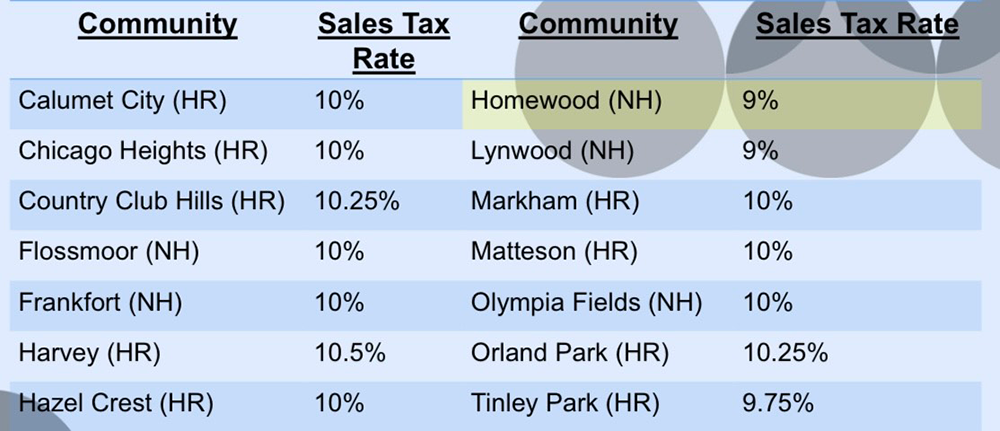


A chart that shows the Village of Homewood's current local sales tax rate, 9%, in comparison to other surrounding municipalities. NH stands for non-home rule (less than 25,000 residents) and HR stands for home rule (more than 25,000 residents). (Provided photo)
Local News

Homewood trustees might consider new 1% non-home rule local sales tax 

Homewood village board members were given information to help them make a decision on adopting a 1% non-home rule local sales tax. Numbers show out-of-town shoppers would be paying the most of the new tax. 

Homewood’s current sales tax rate is 9%. Of that, 6.25% goes to the state, 1.75% goes to Cook County and 1% goes to the Regional Transportation Authority. The village receives 1% of the state’s sales tax collections. 

If the additional non-home rule sales tax were to be implemented, that would increase the rate to 10%. Trustees are expected to vote on the proposal at the board’s Sept. 9 meeting.

Amy Zukowski, Homewood finance director, said the 1% tax is a new option available to non-home rule municipalities. She told trustees at the Aug. 26 meeting that Homewood, with a population of 18,789, doesn’t meet the 25,000 threshold for home rule status, so options to raise revenue are limited.

In August 2024, Gov. J.B. Pritzker signed legislation allowing non-home rule communities to collect a 1% sales without getting approval from voters. Non-home rule sales tax does not apply to the purchase of vehicles and prepared food, nor groceries and medicine, Zukowski said. 

A chart that shows the Village of Homewood's current local sales tax rate, 9%, in comparison to other surrounding municipalities. NH stands for non-home rule (less than 25,000 residents) and HR stands for home rule (more than 25,000 residents). (Provided photo)
A chart that shows the Village of Homewood’s current local sales tax rate, 9%, in comparison to other surrounding municipalities. NH stands for non-home rule (less than 25,000 residents) and HR stands for home rule (more than 25,000 residents). (Provided photo)

Non-home rule municipalities are limited in terms of how they can generate more revenue for village operations. Homewood’s current operating budget is $27.7 million, which goes towards funding staff and services, purchases and repairs, Zukowski said. 

The establishment of the 1% local sales tax would generate an estimated $3.5 million to help fund the village’s capital needs. This includes funding projects, such as the lead service line replacement project, which is mandated by the state and is estimated to cost $70 million. The additional revenue would also go towards road and infrastructure improvements, as well as pensions, she said. 

It is a challenge managing rising costs that outpace revenues, Zukowski said. 

“Contrary to popular belief, it is sales taxes, not property taxes, that successfully fund Homewood’s many services and amenities,” Zukowski emphasized. 

Survey results from Retail Coach, a consultant hired by the Village of Homewood, show the proportion of shoppers from Homewood and those from elsewhere. (Provided image)
Survey results from Retail Coach, a consultant hired by the Village
of Homewood, show the proportion of shoppers from Homewood
and those from elsewhere. (Provided image)

Homewood property owners pay only 11 cents of every tax dollar to the village. The largest share of property taxes goes to schools. Homewood collects $7.25 million. This is lower in comparison to the Village of Park Forest for example, which receives about 40 cents of every dollar paid by their property owners, she said. 

Of the $7.25 million in property taxes, the village spends:

  •  $747,000 for principal and interest on a $2 million bond.
  •  $4 million for police and fire pensions, and non-public safety retirement funding. 
  •  $2.5 million for village general fund expenses, or about 9% of village costs. 

Zukowski said sales taxes provide the village with $6.2 million, or 22% of the budget.

Homewood also collects other taxes, including on cannabis sales, personal property replacement, places for eating, utilities, real estate, licenses, permits and fines. In total, 76% of Homewood’s budget is funded by taxes, she said.

As for the gaming tax generated from Wind Creek Casino, which opened in November 2024, Zukowski estimated the village will receive about $1.1 million, which is only 4% of the village’s operating budget. 

The village worked with a company to assess its sales taxes. According to a survey, about 88% of the sales tax generated in Homewood’s Halsted Street business corridor comes from non-residents. In 2024, over 60% of Homewood’s sales tax revenue, or $3.6 million, came from those sales. In Homewood’s other shopping areas, non-residents account for between 72% and 85% of sales, Zukowski said. 

“It’s a tax that other outside community members can fund, but the actual proceeds of this tax will only benefit Homewood residents,” Napoleon Haney, Homewood village manager, said, adding, “it’s a rare opportunity.” 

“The village has invested so much into so many different areas that this is an opportunity to recoup some of those losses without over-burdening our residents,” Trustee Patrick Siemsen said.  

This is the best route to take rather than negatively impacting residents with higher property tax bills, Zukowski said. 

If implemented, the 1% non-home rule local sales tax will go into effect Jan. 1, 2026. 

Advertisement
Popular stories < 7 days

Newsletter

Meet the Candidates: U.S. Senate

Conversations with the Chronicle