

Public safety and quality of life are intertwined values that are top priorities in our community, but achieving both is complicated by a powerful force: American culture, specifically its preferences for guns and speed.
Of course, Homewood and Flossmoor are very safe villages. We have much less crime than many communities in the region. We enjoy the benefits of excellent village services and good governance. But we still experience problems common in communities across the country, including shootings and speeding.
On Monday, July 21, for example, someone shot my house.
It happened about 5:30 p.m. I heard about six or seven loud bangs right outside. One bullet hit our house, but it just punctured the siding and didn’t get inside. By the time I got to the window (maybe that wasn’t a good idea, now that I think of it), I could see no vehicles or pedestrians that might have been involved.
The incident has stirred fears in our neighborhood in part because this is the fourth drive-by shooting since April. Olive Road is a quiet street where people routinely walk their dogs, kids play in yards and ride their bikes around and people young and old visit the ash tree Little Free Library to exchange books.
It’s pretty idyllic.
The response of residents along Olive, Hickory and Elder roads has been encouraging. They have responded to this spike in scary incidents by coming together to address the problem. Thanks to the efforts of then-trustee Allisa Opyd, who lives in the neighborhood, the village hosted a meeting on April 28 at James Hart School to answer residents’ questions following two shots-fired incidents within 24 hours on April 20 and April 21. In one of those incidents, a house in the 1100 block of Olive Road was struck by four bullets. That’s a half-block from the school.
About 75 residents showed up, and asked questions for more than an hour. It wasn’t a one-and-done thing. In May, several neighbors called a meeting and more than 40 people showed up to continue the conversation and discuss next steps.
The consensus was that the neighborhood needed to organize. A number of people volunteered to be block captains, and they have met several times since, including one meeting with Les Rodgers of Flossmoor, the former law enforcement officer who founded the Ballantrae neighborhood watch. He provided a wealth of good advice for how neighbors can work together to keep everyone safer.
At the July 22 village board meeting, after several residents expressed their dismay over the incidents, Mayor Rich Hofeld said the drive-by shootings were unacceptable. He pledged that the village would support efforts to address the problem.
The context for this effort is a culture that loves guns so much that we’ve engulfed the country in weaponry. There are 340 million people in the country and 1.2 guns per capita. That’s more than 400 million guns. That ratio creates more opportunities for misuse, like firing shots in residential neighborhoods, not to mention worse mayhem.
Our neighborhood isn’t likely to put a dent in that situation, but we can change the conditions on the ground to protect our peace and make the area inhospitable for gunslingers. The folks on Olive, Hickory and Elder roads have the best tool available to counter such trouble: community.
America loves speed
I did an experiment on Thursday, July 24. I had to borrow my son’s car to haul Chronicle material to Flossmoor for our table at Chamber Night. I traversed 183rd Street from Governors Highway to Riegel Road twice. I pegged the spedometer at the speed limit, 30 mph. On the first trip, five of seven cars passed me. On the second trip, five of five cars passed me.

Speeding on 183rd Street (and elsewhere) was a hot topic a couple of years ago. After a fatal crash at 183rd and Center Avenue in 2020, the Homewood commissioned a traffic study. One suggestion from that study was to consider a traffic calming lane reconfiguration. Rather than the current four lanes of vehicle traffic, there would be two lanes of traffic, a center turn lane near intersections and bike lanes on each side. The purpose of the new lane design would be to slow traffic and make the street safer for pedestrians and cyclists.
After a lane realignment test in May 2022, village officials seemed eager to implement the change. The village board authorized an application for a state grant to help pay for it.
Village interest has cooled since, but a group of cycling advocates are hoping to bring the project back into the public conversation.

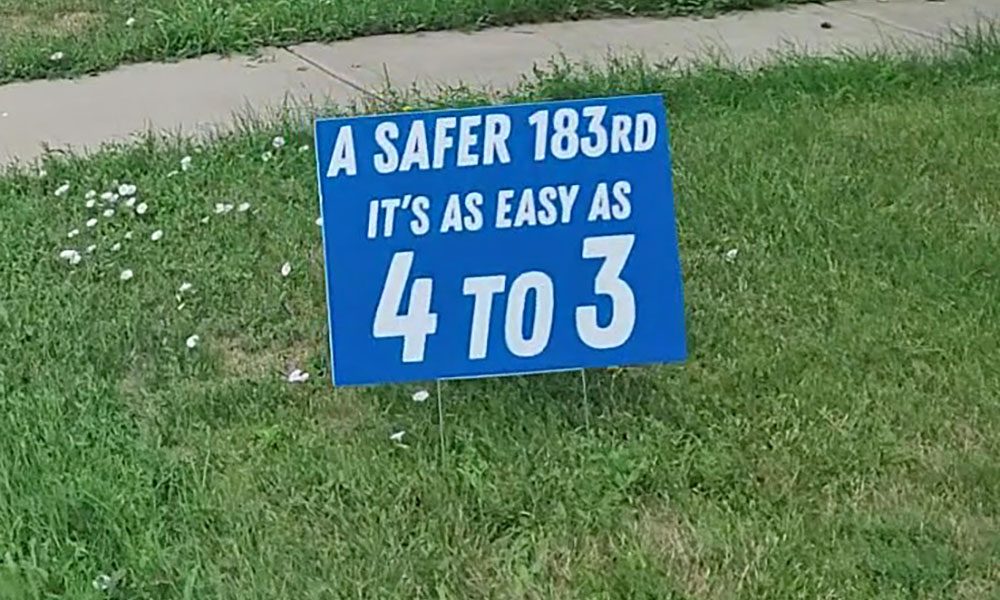
popping up on lawns last week. “A safer 183rd. It’s as easy as 4 to 3.” refers
to an option in a 2022 traffic study that would convert 183rd Street from
four traffic lanes to two plus a turn lane from Morgan street to Dixie Highyway.
(Eric Crump/H-F Chronicle)
At the July 8 board meeting, Kristen Salkas and Barb Lawler asked about the status of the project. Village officials were more interested in talking about a proposed traffic light at 183rd and Center Avenue than about the traffic calming project.
Full disclosure: I’m part of that group. Cycling is my primary means of transportation, which means I have a different experience negotiating 183rd Street than drivers do. It can be scary. So I have a stake in slowing 183rd Street traffic.
Again, American culture is a factor. We love cars. We love speed. There are 10 films in the “Fast and Furious” franchise for a reason (and an 11th is in the works).
I’m skeptical that efforts at persuasion or enforcement will make 183rd Street safer. The village tried a public safety education program, “Slow Your Roll,” that included village-provided “Pace car” magnets people could put on their cars to remind other drivers to slow down. I had three on my car before I sold it. They didn’t seem to help much. Anyone who has tried going the speed limit on 183rd knows that it’s an invitation to eat some dust from the cars and trucks zooming past.
Enforcement has been increased on 183rd Street. It’s common to see speeders pulled over. Still they speed.
The late Jim Wright noted in his 2004 history, “Homewood Through the Years,” that soon after cars appeared in the village, reckless driving became a problem. In 1917, the village installed a four-way stop light at the intersection of Dixie Highway and Ridge Road (then known as Main Street). It got hit so many times that the wooden pole had to be replaced by a concrete structure.
So this problem is not new. It’s not easy to solve. But just as with the gun problem, I think changing the conditions on the ground might be the most effective way to improve safety and quality of life. Changing the landscape is arguably more feasible than trying to change drivers’ minds and habits.


