


Local News

Homewood enlists state help after local environmentalists raise alarm over toxins in Izaak Walton pond

Local environmental activists are raising alarms about toxic substances entering a small pond in the northwest corner of Izaak Walton Preserve in Homewood.

David Zaber, an environmental scientist who is a member of the Izaak Walton board, said he first noticed something unusual about the pond while looking at online aerial views of the preserve in December 2020.

“I was looking at aerial photographs and I’m like, ‘That pond doesn’t look like it should be orange,'” he said during a visit to the site on Sept. 23.

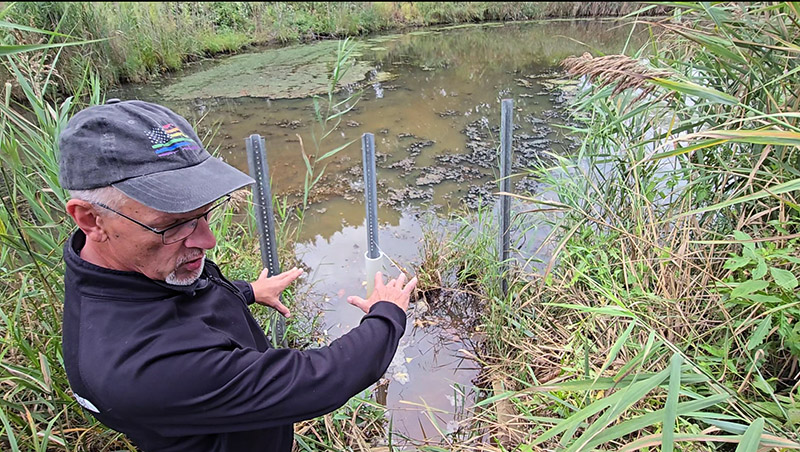
Dave Zaber lifts a boom from the water that is intended to corral oily substances flowing into an Izaak Walton Preserve pond. (Eric Crump/H-F Chronicle)
Dave Zaber lifts a boom from the water that is intended to corral oily substances flowing into an Izaak Walton Preserve pond.
(Eric Crump/H-F Chronicle)

Although the orange color could be attributable to iron content in the water, as village officials have suggested, Zaber said he feared there were other causes and asked Izaak Walton and village officials to investigate.

In an August letter to the village, Izaak Walton officials noted that the village installed an absorbent boom across the inflow to the pond in 2022. However, the booms “were inadequately sized, improperly placed at the outfall, and not properly maintained. As a result, oily sheens continued to enter the ponds,” the letter stated.

The red arrow shows the location of the pond in the northwest corner of Izaak Walton Preserve that a test shows contains toxins. (Provided image)
The red arrow shows the location of the pond in the northwest corner of Izaak Walton Preserve that a test shows contains toxins. (Provided image from May 2023)
The pond in the northwest corner of Izaak Walton Preserve has been found by one test to have elevated levels of toxins. The pond, seen here on Sept. 23, has at various times takes on an orange hue that first alerted a local environmental scientist that there might be a problem. (Eric Crump/H-F Chronicle)

Zaber said the village failed to take additional action until April 2023, when village officials agreed to split the $6,500 cost of water testing with Izaak Walton. The sample was taken in November 2023, and the report was delivered in February.

A copy of the report was provided to the Chronicle by Zaber and Liz Varmecky of South Suburbs for Greenspace.

According to the report, samples of water and sediment were taken from near the outfall into the northwest pond and sediment was taken from a second nearby outfall.

The results indicate the presence of a number of substances in the sediment at a level that exceeds U.S. EPA screening levels, which means further investigation is warranted, according to the report.

Environmental activist Liz Varmecky of South Suburbs for Greenspace discusses her efforts to gather information from various government entities that have jurisdiction over water flowing into Prairie Lakes at Izaak Walton Preserve. (Eric Crump/H-F Chronicle)
Environmental activist Liz Varmecky, left, of South Suburbs for Greenspace discusses her efforts to gather information from various government entities that have jurisdiction over water flowing into Prairie Lakes at Izaak Walton Preserve. (Eric Crump/H-F Chronicle)
A gnawed tree near the northwest pond at Izaak Walton shows evidence that wildlife could be exposed to toxins in the sediment, according to local environmental activists. (Eric Crump/H-F Chronicle)

The letter from Izaak Walton specifically highlights the presence of a number of substances collectively known as polynuclear aromatic hydrocarbons (PAH).

“PAH levels in sediment surpass those of typical urban areas in Cook County and non-urban backgrounds. … For instance, Benzo(a)pyrene concentrations are about six times higher than in urban Cook County and 12 times higher than in cleaner, non-urban locations,” the letter states. “PAHs pose significant health risks to both humans and wildlife. Due to their harmful effects, environmental persistence, and their ability to accumulate through the food chain, these contaminants are classified as priority pollutants.”

The testing report concludes with recommendations for dye testing to verify the source of water flowing into the pond, further monitoring and testing of the pond and an analysis of storm sewers in the area.

Zaber said the village did conduct one dye test in March 2024, which he said indicates the source for the toxins is a sump pump at Homewood Disposal.

A Homewood Disposal spokesman said the company is aware of the situation.

“We understand the Izaak Walton Preserve or an Izaak Walton board member has concerns in connection with our office building adjunct to the preserve. It’s our understanding the IEPA and the village have been contacted to investigate this further,” he said. “During construction in 2004, our office building was built according to village codes and regulations. We also worked extensively with our Izaak Walton neighbors to ensure their satisfaction with how the building was constructed and the land was used in relation to the preserve. We are happy to continue to work with the village as needed.”

Water enters the pond from nearby storm water drainage systems. The pond is part of the Prairie Lakes detention basins, which were created to help alleviate flooding in the northeast section of Homewood.

“This is a storm water drain, but it’s connected to the contaminated groundwater,” Varmecky said. “It’s not that Homewood Disposal created the toxins, but they are now responsible for moving the toxins into our system,” she said.

Izaak Walton Preserve in Homewood is home to wildlife that environmental activists worry could be affected by toxins in a pond near Prairie Lakes. (Eric Crump/H-F Chronicle)

Varmecky said the presence of toxins in the water and sediment might not be an immediate danger to people. The pond is small, shallow and sheltered by vegetation, making it an unlikely spot for recreational uses.

But she pointed out that the water flows into Prairie Lakes nearby, where people do fish sometimes.

The area also is populated by wildlife that can be affected by the toxins and can spread them throughout the preserve, she said. She pointed to a beaver-gnawed tree just a few feet from the outfall into the pond.

Zaber noted that Sand Lakes, which are on the southeast side of the preserve, are at a higher elevation than Prairie Lakes and therefore are not affected by the water quality issues in the pond.

He said he decided to go public with his concerns about the toxins in the pond because he did not think the village was taking the matter seriously enough.

“I gave four years of time to be nice about it, to work together. And to this day it’s leaking,” he said.

He noted that the sheen on the surface of the pond includes two similar-looking substances. One is the product of bacteria processing iron. The other is oily hydrocarbons. He pointed out the difference in the way the two substances behave.

“They keep saying, ‘Oh, it’s all natural.’ And I’m like, ‘No, it’s natural stuff in a soup of illegality,'” he said.

Village Manager Napoleon Haney said previous interactions on the issue were primarily between Izaak Walton and the village public works department. When he was made aware of the situation, he contacted the Illinois Environmental Protection Agency for assistance, he said.

“This is beyond our scope of expertise,” Haney said. “We asked (IEPA) if they would get involved and help us figure this out.”

At the Homewood board meeting on Sept. 24, resident Kevin Crabtree addressed the issue and asked the village to take action. He noted that his family bikes past the northwest pond sometimes.

“Every time we’ve ridden through the past month there have been people with fishing poles. I wanted to throw up, because I don’t know if he’s eating that fish or not,” Crabtree said. “My ask as a member of the community, a father and a friend, please stop whatever contamination is happening. Immediately. Do whatever you need to do.”

Haney assured him the village was working with IEPA on the matter.

“We had our first meeting last week. They are involved now in a fact finding mission,” he said. “We’ve shared with them what outfalls (drain) into Prairie Lakes. I told them I would call them every week to get a status report.”

Zaber and Varmecky, in the meantime, are building a public awareness campaign about the situation. They plan to hold tours of the preserve that will offer explanations of “the science issues, civic issues and impact on people, pets and wildlife,” according to a Facebook post on the Oct. 27 tour. “The focus of this event is education, and empowering residents with information and solutions that will lead to the end of the toxic discharge and remediation of the affected ponds.”

Advertisement
Popular stories < 7 days

Newsletter

Meet the Candidates: U.S. Senate

Conversations with the Chronicle