
Gov. J.B. Pritzker announced Thursday that every region of the state has met the health benchmarks to advance into Phase 4 of the Restore Illinois plan on Friday, June 26. The state also has several new efforts to build on the response to COVID-19.
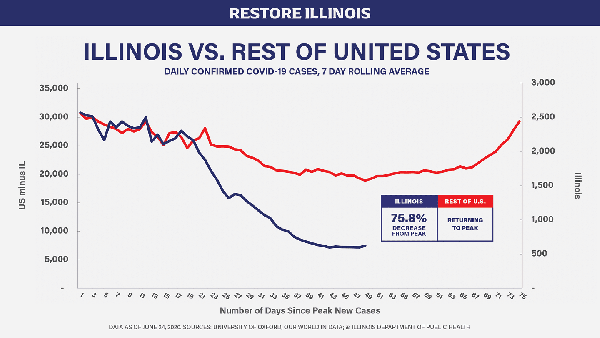
“Many other states are now seeing significant increases in cases, hospitalizations and intensive care bed usage and they’re being forced to move backward and stay at home. That’s not the story in Illinois,” the governor said. “Here, we have been gradually restoring business and leisure activities in a highly deliberate manner, guided by doctors’ advice.
“Illinoisans are following the mitigations that we can each do ourselves, like wearing face coverings, keeping 6 feet distance between us, and washing our hands frequently. It’s because of the people of Illinois that we’re seeing a trajectory of relative success where other parts of the country are not.”
Phase 4 metrics
Pritzker said all four Restore Illinois health regions have seen reductions in the positivity rate and hospital admissions and availability of hospital surge capacity.
On a statewide level, statistics show Illinois flattened the curve, passed the peak and saw a sustained decline in key metrics since the coronavirus pandemic began. Looking at 7-day rolling averages – which smooth out daily fluctuations and allow trends to emerge – Illinois is seeing marked declines in cases, deaths, case positivity and COVID-19-related hospitalizations.


Testing and tracing
The state has built up its daily testing capabilities, surpassing 30,000 tests in a 24-hour period for the first time Thursday, June 25.
Illinois is continuing to build on this progress, launching 12 mobile community testing teams. The testing teams will move throughout the state to mitigate and suppress emerging outbreaks, including places like meatpacking plants, nursing homes or other traceable gatherings.
The state reports mobile teams will operate in partnership with a network of commercial labs allowing test results to be quickly delivered.
The state also continues to build up its statewide contact tracing capacities, increasing the ranks of contact tracers by 20 percent since June 1. Today there are more than 550 active contact tracers across the state, and another 250 new tracers will be available in the coming weeks. Illinois continues to scale up operations, including using new technology to multiply the state’s effectiveness in its contact tracing efforts.
In addition, all of Illinois’ 97 local health departments have applied for a share of the $230 million available for contact tracing. Those funds will be disbursed in the next few weeks.
Community based organizations will have the opportunity next month to obtain funding through IDPH to collaborate on contact tracing efforts alongside their local public health departments.
County level risk metrics
The state is also launching a new county-level risk assessment tool to help individuals, families and community groups make informed choices about personal and family gatherings, as well as other activities.
The county-level indicators are similar to the Restore Illinois criteria. By applying the same metrics to each county, IDPH is using a standardized approach to monitor the state as a whole. Each county will be assessed, using a color-coded system, to determine whether it is meeting or exceeding each indicator target. The measurements will help officials and the public make sound decisions on promoting healthy behaviors during Phase 4.
To view the online county risk assessment tool, visit here.
To view the guidelines for all industries reopening in Phase 4, visit here.