




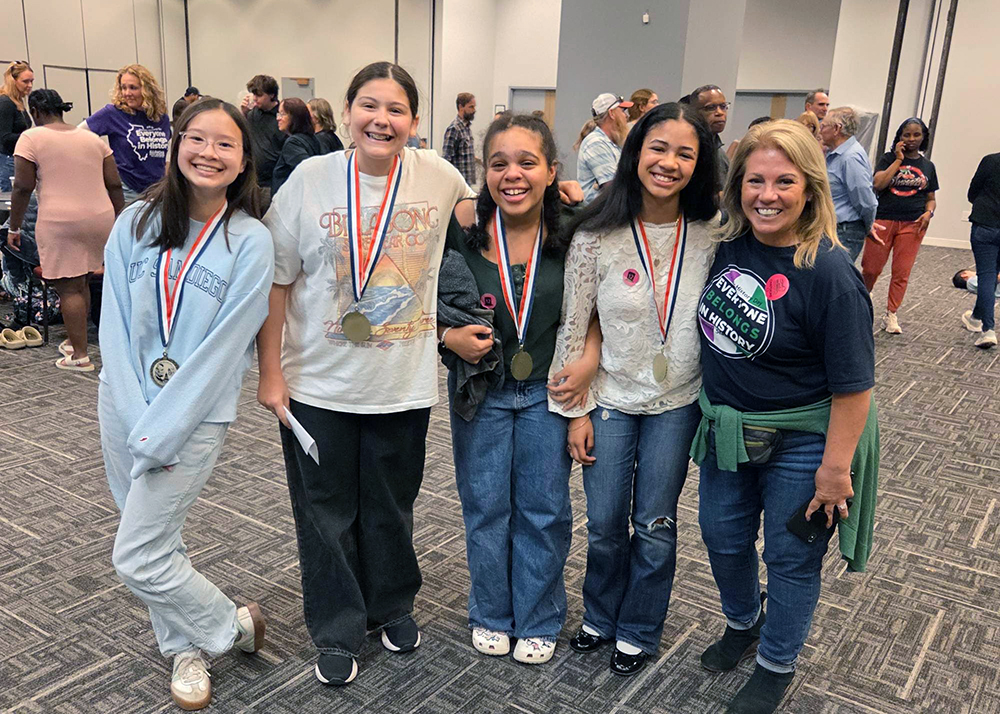
Parker Junior High students are headed to a national meet after winning first place in the Illinois History Day competition performing an Illinois case that led to employee safety reforms.
The team will be at the University of Maryland June 14 through 18 competing in the middle school division for national honors.
Avery Cheung, Emma Santiato, Sophie Folaju and Dahlia Thomas competed in the group performance category at the state competition in Springfield on April 27 after winning at regional competition in Chicago.
Their presentation, “Voices of the Dead with Chester Hughes: Radium Girls Reforming History Beyond the Grave,” tells the story of women who were poisoned when they worked at the Radium Dial Co. in Ottawa, Illinois, in the 1920s and 1930s.
The students used a TV show interview format. The first half of their presentation had the girls talking with host Chester Hughes about their exciting jobs making watches that would glow in the dark.
Years later they return — as ghosts — to tell the host of their ailments and complaining that he did nothing to bring the issues around radium poisoning to light.
Illinois Radium Dial Co. hired women to paint watch and clock dials with radium-laced glow-in-the-dark paint.
The watch dials were so small, the work required brushes to have a fine point. The women put the radium on the brush and then put the brush in their mouths to create the fine tip. By doing that, they unwittingly ingested the radium that would later cause sarcomas, brittle bones and loss of limbs and jaw bones.
Officials at Radium Dial learned as early as 1925 that the radium was injuring the workers but told staff they were healthy.
Catherine Donohue, who had worked at Radium Dial for six years, was fired in 1931 because she limped from hip pain and it was raising concerns among the staff. She became bedridden and it was years later that a doctor confirmed she had radiation poisoning. She and several others filed suit. They were called “the society of the living dead.”
A first lawsuit failed, but Illinois responded by passing the Illinois Occupational Disease Act.
Eventually, their suit did go before the Illinois Industrial Commission in 1938, and Radium Dial was found liable. The company had moved out of state and the most it paid was a lump sum of $10,000 to the women.
The efforts for safety reforms in the workplace by the radium girls eventually led to the federal Occupational Safety and Health Administration in 1971.
The extensive research on the project taught the team that the company “tried to cover it up,” Emma said.
“It’s a very sad story because they all died,” Sophie added. “That really changed so much because when it was first discovered, they saw a new material (radium) and thought it was like magic, so they put it in literally anything.”
The girls even traveled to Ottawa to look for Catherine Donohue’s grave. For a woman who had meant so much to the reform movement, they were surprised that her grave was hard to find and not well tended.
Teacher Linda O’Dwyer, who has worked with winning teams the past dozen years, said the work started in October and went through February.
“There’s a lot of research. They had to build an argument. That work falls in line with their ELA (English/Language Arts) standards as well. … What motivates them, I think, is you can make it your own project and interpret it your own way.”
