

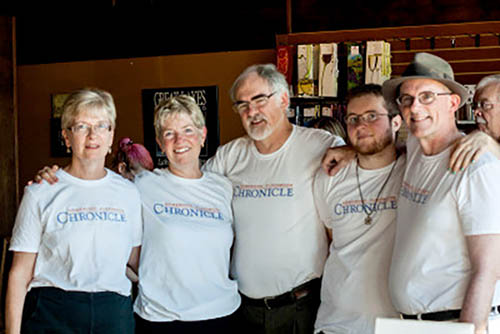

From left, Marilyn Thomas, Patty Houlihan, Tom Houlihan, Quincy Crump and Eric Crump at the 2015 fundraiser to support the H-F Chronicle's first print edition, published in December 2015. (Provided photo/Sandra Armenteros)
Local News, Opinion

Commentary: Tom Houlihan had ink in his veins, community in his heart

There’s an old saying to describe any dedicated newsman, passionate about the craft of journalism and obsessive about keeping his community informed. “He has ink in his veins.”
It seems like a good characterization of Tom Houlihan, however cliché that might be to say.
Tom died on Nov. 23.

When I met him in the fall of 2014, Marilyn Thomas and I had been writing stories for the young Chronicle for a few months, and she said we ought to see if Tom would be interested in helping.

Marilyn put it best:

“When Eric proposed a paper for Homewood, I knew I’d contact Tom. He said he’d join us if we also covered Flossmoor, and he took that beat. After his many years at The Star, thinking about a new community paper got him excited. He gave The Chronicle introspection, knowledge of community and place, an editor’s eye and a reporter who got the story by befriending people from all walks of life. And we know readers appreciated his monthly columns for the print paper.

“I’ve been a friend of Tom’s for over 40 years. He first was my colleague when we worked together in the Illinois bureau of The Times newspaper based in Hammond, Indiana. Although our work relationship ended, the personal friendship continued. We’d swap stories about our kids, work and the state of the world over lunches or dinners. One of the last things he said to me was that he loved me. I was touched, because I loved him too.”

From left, Marilyn Thomas, Patty Houlihan, Tom Houlihan, Quincy Crump and Eric Crump at the 2015 fundraiser to support the H-F Chronicle's first print edition, published in December 2015. (Provided photo/Sandra Armenteros)
From left, Marilyn Thomas, Patty Houlihan, Tom Houlihan, Quincy Crump and
Eric Crump at the 2015 fundraiser to support the H-F Chronicle’s first print
edition, published in December 2015. (Provided photo/Sandra Armenteros)

What immediately impressed me about Tom was that he had already done his bit as a reporter and editor, serving our area well for many years. His legacy was secure. He deserved time to pursue retirement projects, including a genealogy study that he finished just before he died.
He sure didn’t have to pick up his notebook and head back out to find the news. But he did.
He didn’t have to go to long board meetings. But he did.

He didn’t have to spend time writing entertaining, edifying columns on subjects ranging from the Great Squirrel War of 2019, the decision to attract a casino to Homewood, the importance of better street maintenance, and the joys of backyard birding and growing paw paw trees. But he did.

He didn’t have to invest so much time, energy and thought into enriching the community with his words. But he did.

At the Chronicle’s one year anniversary, he wrote:

“I am trying to give back to the H-F community and, I hope, help to keep it strong.”

He succeeded. We won’t forget him.

Creating community

Diane Nash has always been one of my favorite Civil Rights Movement heroes.
I was delighted to have a chance to see her speak on Oct. 18, which happened to be the day of the No Kings protests, at a Top Ladies of Distinction event in Woodlawn. My thanks to organizer Elaine Chisholm for the invitation.

In her remarks, Nash told a compelling story about how to convert adversaries into allies (or close to).

She was living alone in Chicago when someone started breaking the windows in her home. She wasn’t able to catch anyone in the act, but she suspected it was neighborhood young people.

“It was summertime. They didn’t have anything to do,” she said.

One day a group of young people  were sitting in the vacant lot next to her house.

“I went out there and I took the time to introduce myself and ask each one their names. I said, ‘You know, somebody has been breaking my windows. I’m sure it’s none of you because you look like intelligent people. And whoever’s breaking the windows is not intelligent,'” she said. “I made it a point to memorize each person’s name. After we talked for a while, I said, well, it was very nice meeting you, John, and Joe and Mary and so forth. And I went back in my house. Never got another window broken.”

Her takeaway? The kids needed someone to pay attention to them, to show that they mattered enough to talk to, to listen to.

“Young black people need to be loved,” she said.

Books Without Borders

Jackie Riffice, founder of the community book club Books Without Borders, continued her practice of providing a report to Homewood and Flossmoor village boards and residents in December. She summarized the discussion about “Stamped: Racism, Anti-Racism and You” by Jason Reynolds and Ibram X. Kendi. 

About 20 people met at Beyond Borders Café in Flossmoor, self included. It was a great conversation. As Jackie put it: “One of the bigger points was that our silence empowers bigots and haters and gives them permission to keep at it. There were quite a few conversations in this room where people felt comfortable voicing their concerns about their silence. Once again, the care and compassion that folks shared with strangers was nothing short of remarkable.”

It was a diverse group, as you might expect in Flossmoor. There were men and women, white people and Black people, all there to learn from the book and from each other.

Riffice added another detail in her report. She said three participants told her there was too much to discuss during the club meetings, so they started meeting weekly to continue the conversation.

That’s encouraging. 

We will be better able to address racism in our community and in the wider world if we’re armed with knowledge and forge connections with each other as allies in the battle.
If anyone has or is considering creating their own public study group or any other project focused on addressing social injustice, email [email protected] and we’ll help get the word out.

The next Books Without Borders meeting will be at 6:45 p.m. on Jan. 27 in Flossmoor Public Library, 1000 Sterling Ave.

The featured book is “Caste: The Origins of Our Discontents” by Isabelle Wilkerson. She explains the parallels between caste systems in India, Nazi Germany and the U.S. 

“Caste” is not a comforting book. Wilkerson forces us to face some grim truths about the very structure of our society. But it’s an important book. 

Another regular speaker at Homewood and Flossmoor village board meetings, Doyle Landry, often closes his comments with, “You can’t fix what you can’t face.” It’s a paraphrase of a famous James Baldwin quote: “Not everything that is faced can be changed, but nothing can be changed until it is faced.”

Wilkerson is a brilliant writer and an able guide through a difficult subject. I hope more people will give it a go. Remember, you’ll make the journey with your Books Without Borders friends.

Better to face the consequences of caste together than alone. 

Advertisement
Popular stories < 7 days

Newsletter

Meet the Candidates: U.S. Senate

Conversations with the Chronicle