


The sandhill cranes are flying over our houses, heading south.
On these cold, clear, late-fall days, their presence is unmistakable. They fly high in the sky and it’s sometimes hard to see the V-shaped flocks of birds that have chosen our towns for the route of their autumn migration.
But you’ll always hear them.
Smaller groups – maybe a half dozen cranes – produce a squawking racket that can be heard for more than two miles. When a flock of 40 birds fly directly above you, it’s like being in the third row of a concert hall when the symphony orchestra is pouring on its most dramatic music.
The sandhills migrate above us in the spring and fall. Their return to the north, early in the year, is a sure sign that warmer days are ahead. When the days get short and the air cooler, the cranes signal the end of the year. They spend their summers in Wisconsin and into Canada and their winters in Florida and other warmer regions.
These are birds that are four feet tall with wingspans of nearly seven feet. They are known for congregating in giant flocks, and for being social animals. We’ve used our binoculars to watch the males of the species do mating dances, during which they jump up in the air and spread their wings.
Right now, more than 10,000 sandhill cranes are congregating at the Jasper-Pulaski Nature Center in Indiana, about 30 miles south of Valparaiso. Hundreds fly back to that location at dusk in late November and early December and that’s a sight you will never forget.
I have mentioned before in this space before that Patty and I are very modest birders. We decided years ago that sandhill cranes are in a class all by themselves. You don’t go looking for them – they choose to make their twice-a-year migration directly overhead and it always makes us happy.
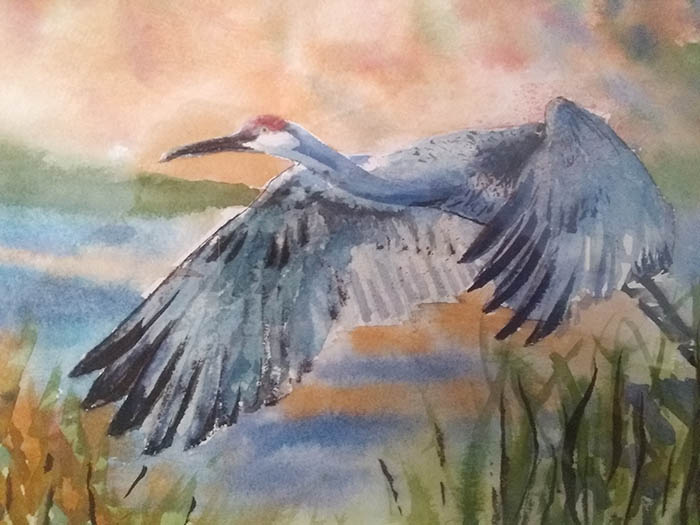
We like sandhill cranes so much that our son Emmett painted a water color of one of the birds and gave it to us as a Christmas present. It’s hanging in in our bedroom so we get to see it every day.
This has been a very hard year that has been scary and filled with disappointments. Right now, we are still threatened by a deadly and invisible virus that is infecting tens of thousands of our fellow Americans every day. There is no telling what “normal” is, or when we will be able to get back to it.
Still, it’s been a year when nature did not disappoint us. The weather in our part of the world was mostly mild and it was, in many ways, a spectacularly beautiful year. Trees and flowers bloomed and we were again reminded how fortunate we are to live in an area with so much luscious greenery.
During the pandemic, Patty and I have tried to get out of the house for a walk nearly every day. Everything we have read tells us that it is a safe thing to do as long as we social distance from other people who are in the same vicinity. There is no doubt that about the health benefits that come from taking a walk. This year we have found that it’s also good for the soul.
And, in a year when nothing seems normal, being in nature reminded us that the world outside was still remarkably in kilter. Starting in the spring we could watch all the plants around us make their glorious way through the yearly cycle. The wildlife was there too – birds and squirrels and deer. Last week we saw a fox run through our yard.
There is so much this year that’s been disturbing and cause for a whole range of emotions from anger to sadness. It is maddening when the world is suddenly turned upside down. This has never happened before in my long lifetime and I hope we never see it again.
But my last bit of advice as a columnist is this. Get outside. Take a walk. Look at how beautiful our world can be, even in a pandemic year.
Truly, I want you all to be in safe and I want us all to be intact when this pandemic ends. We have children and grandchildren of our own and want the world to return to a place when they can thrive without fear of getting sick from the virus.
Those sandhill cranes, though, are just one reminder that the world is a very big place and that it includes wonders that serve as a constant reminder of how fortunate we are to be alive. And to watch the sky with a sense of awe that will always amaze us.
This is my last column for the Chronicle. Over the years, I estimate that I have written about 1,000 columns, most of which were once-a-week pieces for The Star over a period of close to 20 years. Those ended shortly after the merger of the Star and Daily Southtown in 2007. After we started the Chronicle’s print edition, in 2015, my partners, Eric and Marilyn, asked me to contribute one for each issue. I have regularly been on Page 11 since then
From time to time, I have to tried to explain the column-writing process and I usually say that I have all these words bouncing around in my head and I am just looking for a way to sort them out. I don’t know if I would describe the process as “fun,” but it is a chance to voice your opinion and at least try to do some writing that, hopefully, makes people think.
Early on, as a column writer, I tended to channel my inner smart aleck but later toned that down a bit and mostly turned to serious subjects. Since childhood, I have thought of myself as a shy, quiet person who had some minor writing skills. I’ve known for a while that writing a column would be the best chance for me to have a megaphone, and I’ve tried to make the most of the opportunity.
One more thing before I go. I really like living in the H-F area, which I think is more interesting than any other spot in Illinois — if not the country. I wanted to share my feelings about our towns – most of which are extremely positive — with my fine neighbors. You all deserve a good journalism product and I thought a column would be a plus for both the Chronicle and the community. At least that’s what I was trying to do.
Take care my friends. And stay safe.