

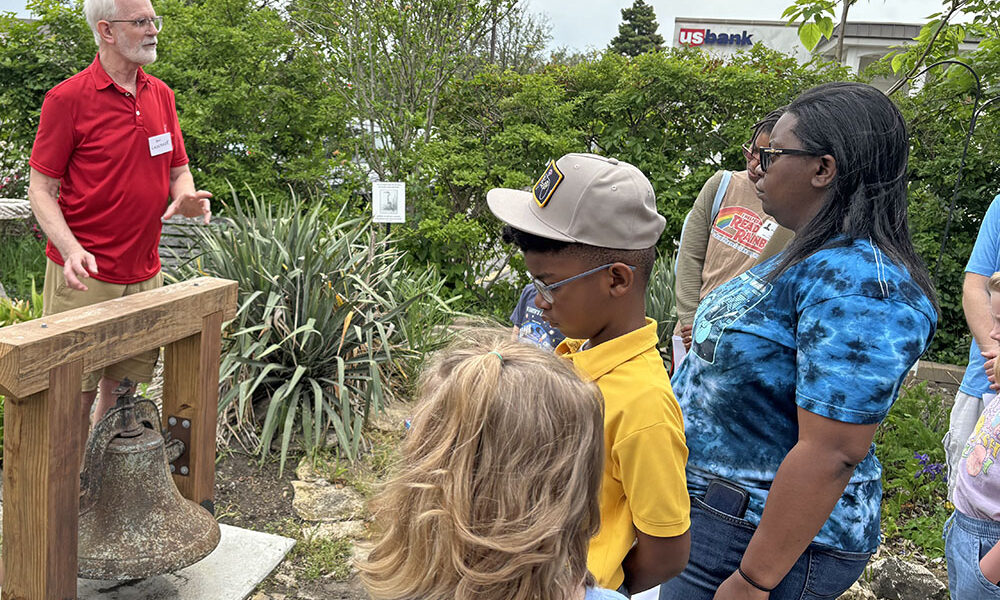

By today’s standards, the house is small. But what it holds are the wonders of a century and more.
Dave McManus’ Willow School class of 19 second graders took a morning excursion May 18 to the Dorband-Howe House, 2035 183rd St., home of the Homewood Historical Society.
Many people drive by the building on a daily basis. This outing gave the 7- and 8-year-olds a chance to check out the surprises inside.
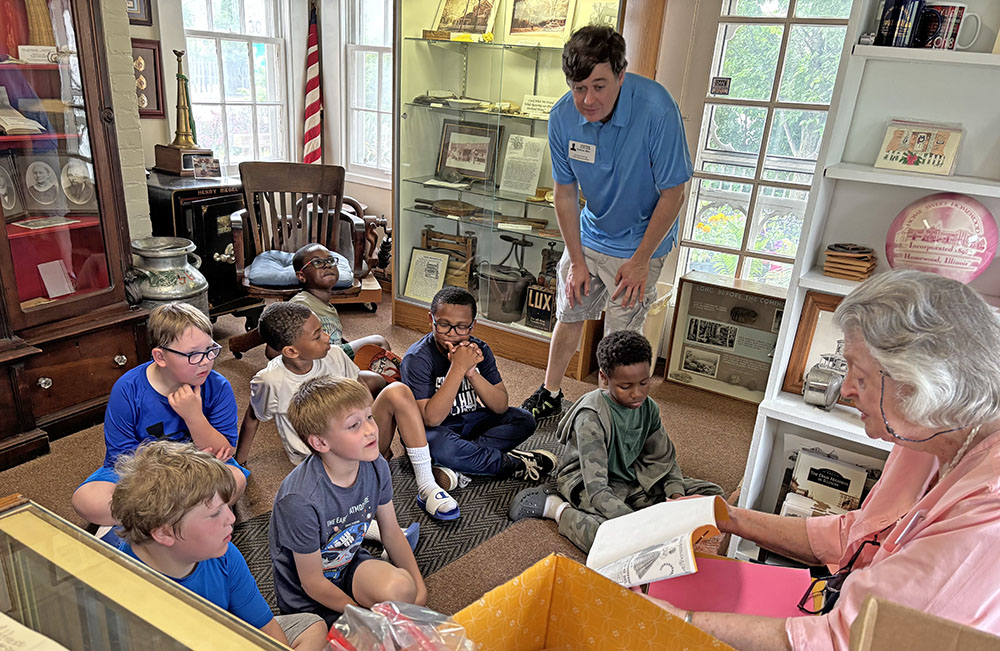
These children can only imagine life for the residents of this house who survived without indoor plumbing and electricity. There were no phones, internet, televisions or video games. Running a house took a lot of time and energy. When the family had free time they played games and cards, listened to music and visited relatives and neighbors.
In the Dorband-Howe parlor is an organ that’s at least a century old, a sewing machine from that era that requires you use a pedal to operate it, furnishing from the turn of the century and an old-fashioned baby carriage.

Homewood Historical Society volunteer Megan Tipton pointed to an outfit hanging from an armoire. The black mock-dress was piped in white and had a little white cap. One child thought it was a maid’s outfit. Another took a guess that the cap was for showers.

at the Homewood Historical Society.
(Marilyn Thomas/H-F Chronicle)
“You’re close,” Tipton said. The dress is a bathing suit from the turn of the 20th century when going to the beach meant young women could enjoy the water, but had to be covered down to her knees. “That all changed with the Roaring ‘20s,” Tipton said.
Travelers didn’t send a postcard but bought a stereoscope picture – two pictures nearly identical side-by-side that you looked at through a special viewer. Tipton passed the stereoscope between the children for them to see the two pictures meld into a 3-D image.
She showed them different implements in the very tiny kitchen, including a handy device that was used to put caps on soda bottles. No Cuisinart products here. Tipton showed the children a board with sharp blades that was used to cut vegetables.
HHS volunteer Elaine Egdorf sat with a book on her lap pointing to historical pictures. When she showed the children a picture of someone wearing a $25 long coat made of dog fur, the children gasped.


In another room, Egdorf told them about the first school buildings in Homewood, and how at one time there was a tunnel under Dixie Highway to help children safely cross the street on their way to school.
Homewood’s long history with railroads is on display in several ways. When Aurora Grande got to ring the locomotive engine bell, the sound was so loud it shocked her and her friends. The Dorband-Howe House also has a school bell that was used to tell children to be in their classrooms.
Each child got to bring home a memory from their field trip, a paper with the name Homewood they rubbed onto paper. After learning about the Homewood Brick & Tile Works, founded by Henry Gottschalk, they sat on the floor with paper and crayon rubbing the name Homewood stamped on the brick.


