




How old is old?
Historians remind us of the farmers who settled Homewood and Flossmoor in the mid-1800s, but the history of the area goes back much farther.
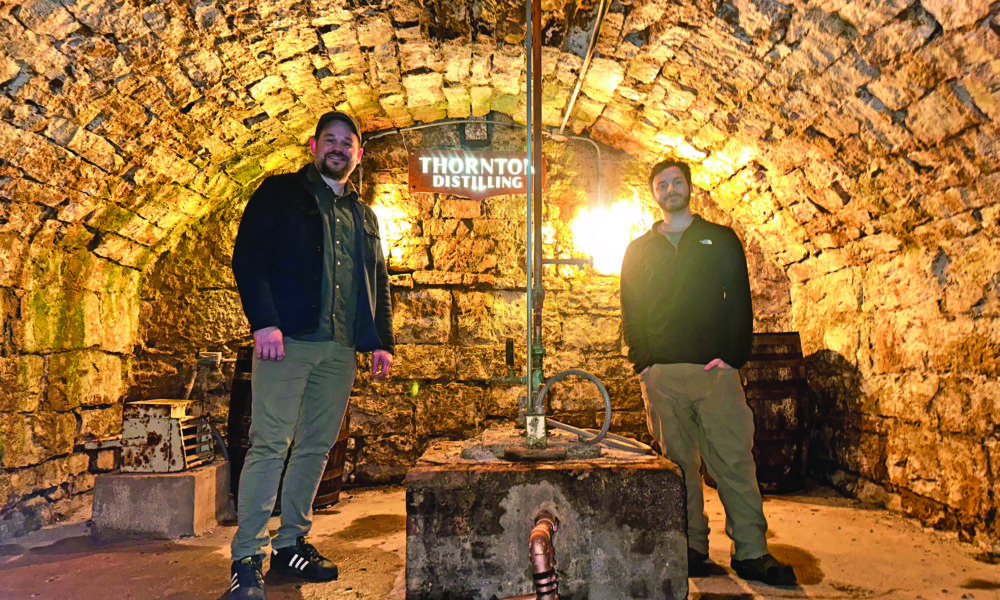
One neighboring site that has a deep historical link is the Thornton Distillery building at 400 Margaret St. in Thornton. Its history goes back to Native American tribes, its first life as a brewery nearly 200 years ago, and its renown during America’s Prohibition period in the 1920s and early 1930s
Today Thornton Distilling Inc. is owned and operated by Andrew Howell and Jake Weiss where they distill Dead Drop Spirits, a traditional malt whiskey, and this month they introduce American single malt whiskeys, that will carry flavors of the American prairie using grains from Illinois and Indiana
Howell shared some of the building’s history.
Note: A version of this story originally appeared at The Lansing Journal in February. Republished with permission.
The spring — and the Council of Three Fires
According to local historian and tour guide Kevin Barron, the story of the land surrounding the distillery predates the structure by centuries.
“The prehistoric history of that building is so neat,” Barron said. “That land — what is now Wampum Lake — was known as the Council of Three Fires.” Wampum Lake is part of the Cook County Forest Preserves District. The area along Thornton-Lansing Road is near the distillery.
The Council of Three Fires refers to the alliance of the Ojibwe (Chippewa), Ottawa and Potawatomi tribes. Barron explained that while many tribes in the region were nomadic, this location was different.
“This was a permanent residency that’s been recorded for at least 900 years,” he said.

Thorn Creek, now shallow in places, was once 12 to 15 feet deep — navigable and vital. Beneath the distillery floor lies a natural artesian spring tapping into the Silurian aquifer, a massive underground water system stretching from Lake Superior into Kentucky.
“The spring is the entire reason our building is where it is,” Barron said. “It’s like a 1,500-foot well. It’s not part of Lake Michigan — it’s underneath it.”
Near the distillery stands a crooked tree angled toward the property. Barron notes that Potawatomi communities were known for shaping trail marker trees.
“They would find a sapling and bend it sideways so it would point at something important,” he said. “There’s a tree right next to Thorn Creek pointing toward our building.”
Pointing toward the spring.

Brewing before the quarry
Brewing on the property dates back to the 1830s with the Berry Brewing Company, long before the current 1857 structure was built by John B. Beilfedt (often spelled Beilfeldt in records). Although beer isn’t made there now, the structure is classified as Illinois’ oldest standing brewery.
“There was no post office, no train yet,” Barron said. “But Thornton already had a brewery. Our priorities were in line.”
For decades, the brewery was Thornton’s largest employer. Before limestone quarrying expanded and reshaped the village economy, beer anchored the town. Families worked inside the building’s limestone walls. Production scaled rapidly. Recovered postcards from the 1880s show beer orders shipped to Crown Point, Indiana, and Grant Park, Illinois.
Howell said the postcards were discovered accidentally during renovation when a cigar box fell from a ceiling cavity.
“Ari (Klafter, head distiller) and I are big nerds about the pre-Prohibition brewing history,” he said.
The Outfit in Thornton
The Temperance Movement in the United States believed prohibiting the sale of alcohol would reduce crime and corruption.
Their efforts led to the ratification of the 18th Amendment to the Constitution. As of Jan. 17, 1920, the manufacture, transportation and sale of alcoholic beverages was banned.
Rather than reduce crime, when Prohibition began organized crime in Chicago accelerated.
Big Jim Colosimo had laid the foundation of the Chicago Outfit. After Colosimo’s murder in 1918, Johnny Torrio reorganized the enterprise into a disciplined bootlegging machine. Torrio’s protégé, Al Capone, would later take control and make the Outfit infamous.
Barron said rumors of mob presence at the brewery circulated for decades, but photographic evidence changed everything.
“A woman emailed us a couple years ago with photos,” Barron said. “One of them shows Johnny Torrio standing in front of the building. Next to him is Big Jim Colosimo, and Carl Ebner — one of the muscle guys for the mob.”


Barron described this photographic evidence as a “mind-blower.”
“It wasn’t just some (Chicago) South Side crew checking in,” he said. “We had the entire administration of the Outfit here.”
During Prohibition, the brewery reportedly operated as a soda bottling plant — a common cover for alcohol production across Illinois.
Thick limestone walls, underground chambers and a constant water source made the building an ideal infrastructure.

And a Colt revolver
In January, Howell found a Colt Model 1903 Pocket Hammerless revolver manufactured in 1921. It was hidden behind mortar in the lower level of the building. It fits squarely into that timeline. The gun had been shoved into a void near what may have once vented a potbelly stove.
“We don’t know who put it there,” Howell said. “But someone hid it intentionally.”
“This is not a service revolver,” Barron noted. “This is exactly what the mob was using at that point.”
“The gun’s really cool,” Howell said.
From beer to limestone
By 1933, it was obvious the Prohibition experiment had failed. Political winds had shifted and the public was increasingly hostile to Prohibition. Congress approved the 21st Amendment repealing the 18th Amendment.
Thornton Brewing continued until 1959. Afterward, the building cycled through uses — a fabrication shop, an auto body business, restaurants — before sitting vacant for more than a decade.
Meanwhile, limestone quarrying overtook beer as Thornton’s dominant employer, reshaping the landscape and workforce. Today the 100-year-old quarry is one of the largest aggregate quarries in the world.
The building’s next life
On Dec. 5, 2019, Howell and partners reopened the space as a distillery on the anniversary of Prohibition Repeal Day, Dec. 5, 1933.
The gangster stories remain a footnote, Howell insists.
“It wasn’t the mob history that motivated us,” he said. “It was the brewing history and the water.”
But the mob history is there.
The photo of Torrio in front of the building is framed on the wall.
The postcards are preserved.
The crooked tree still leans toward the spring.
And the 1921 Colt revolver, once sealed behind limestone mortar, now hangs in a display case above the very chamber where it was found.
The spring that never stopped
The spring connects it all.
Below the frost line, the well chamber remains bone-dry except for the flowing fountainhead. The water is naturally pressurized, limestone-filtered and mineral-rich. Klafter — the head distiller, who studied brewing and distilling science in Scotland — said the water provides a fermentation advantage.
“It filters out heavy metals and adds nutrients yeast loves,” Klafter said. “There’s really a DNA in everything we do because of that water.”
During Prohibition, that same spring would have provided consistent production capability.
Native Americans with their settlements dating back 900 years. Immigrant brewers. Big Jim Colosimo’s Outfit. Johnny Torrio’s expansion. A loaded handgun hidden in stone.
Thornton’s history does not sit in one era. It flows — steady, pressurized and persistent — from beneath the floor.


