

The Illinois State Board of Education has selected four District 153 staff members to receive special recognition through the Those Who Excel program.
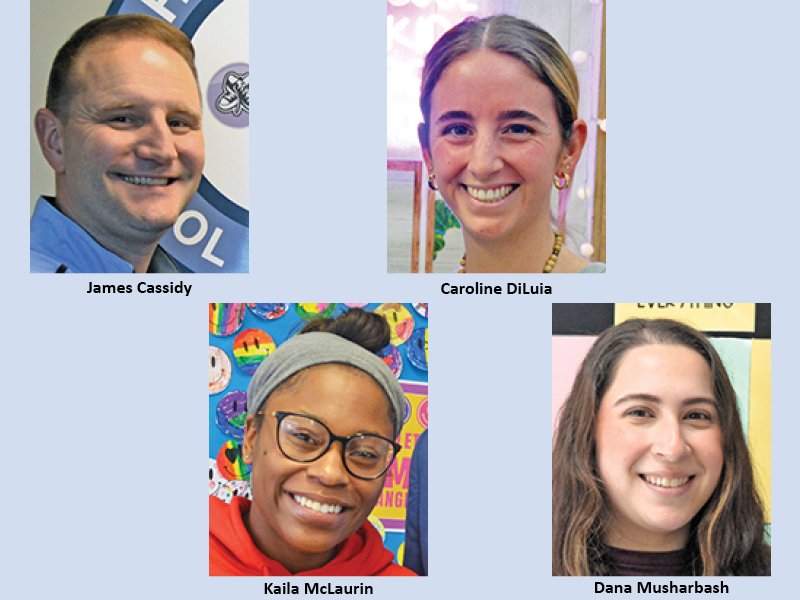
Honorees are James Cassidy, administrator in the Information Technology Office, recognized in the School Administration category; Caroline DiLuia, a Willow School kindergarten teacher, recognized in the Early Career Education category for those in their first five years on the job; Kaila McLaurin, an instructional assistant at Willow School, recognized in the Educational Service Personnel category; and Dana Musharbash, a fourth grade teacher at Churchill School, recognized in the classroom teacher category.
ISBE has sponsored the Those Who Excel program for 55 years. The awards honor educators who have made significant contributions to public and nonpublic elementary and secondary schools and will be feted at a banquet April 18 in Normal.
James Cassidy

When James Cassidy started in education nearly 20 years ago, he trained to be a business and tech teacher for junior high and high school students. Taking a technology teacher’s position at District 153’s Millennium School 17 years ago required him to earn another certification to take over the computer lab for fifth graders.
“Things have really changed over the years,” Cassidy said. “It’s nowhere where it is today where technology is a tool and helps educate, and it’s used in the education process. Technology is embedded in their everyday lessons” at James Hart and Churchill Schools. The youngest students at Willow School also have iPads that stay at school.
The district no longer has computer labs. At the start of the COVID pandemic, every child in the district was given a device to take home with them for remote learning when schools shut down for 18 months.
The immediacy of the shutdown put extra stress on the staff in the Information Technology Department who worked to accommodate students, teachers and staff.
“Cars would line up outside the door of James Hart and if you didn’t have a device we would hand it off to you,” he remembers. Cassidy applauds his co-workers who worked together to get through a very trying time.
Cassidy left the classroom several years ago to take on administrative tasks. He’s working directly with the IT specialists at Churchill and Willow Schools, and an instructional coach at Hart School helping incorporate technology into the classroom. He visits the schools on a regular basis and oversees monthly trainings for staff.
“I think it’s the best job in this district,” he said. “I collaborate, I enjoy coming to work every single day, and I have fun with the members of my team.”
Caroline DiLuia

Growing up, Caroline DiLuia knew she wanted to be a teacher. When she was about to graduate from Marian Catholic High School, DiLuia said she started to doubt her choice, but then she realized she “wanted to make a difference in someone’s life.” Throughout her college years at the University of Dayton, DiLuia said she knew teaching was the right choice.
“I enjoy it and look forward to coming to school every day,” she said.
Her kindergarten classroom is full of lively 5- and 6-year-olds who love coming to school, too.
“They can make learning very fun. I see what I do matters in their lives. Not only are they learning academic skills but they’re also learning great life skills by playing and sharing,” DiLuia said. “They come in not knowing a lot of things, but then they leave and they’re reading!”
This is only her second year teaching but DiLuia said “because I’m such a new teacher I come to the table with a lot of new ideas and fresh experiences” and stresses she has a willingness to learn to be a better teacher. “I emphasize academics, but we really prioritize life skills and solving problems, facing challenges.”
She helps her students move forward, no matter how hard a task may seem at the time.
“I want them to try their best,” she said. DiLuia uses routines and procedures to help the students know their classroom expectations.
Kaila McLaurin

Kaila McLaurin is Willow School’s helping hand. The instructional assistant is assigned to second grade, primarily with students who have behavior issues, but she will happily lend a hand and an ear to a student at any level.
A Homewood-Flossmoor High graduate, she received a degree in psychology from the University of Wisconsin-Parkside. There wasn’t a graduation ceremony because it was a COVID year. McLaurin didn’t know what kind of work she’d do. Initially she thought she’d continue for an occupational therapist degree, but at the time she wasn’t interested in an advanced degree.
She came to Willow a little over three years ago after working at an outpatient facility for adolescents with special needs. She got board certified as a behavior analyst. A teacher friend suggested she try a school setting.
Working at Willow, “I get a lot of joy. I feel happy when kids meet their goals. I feel good helping students with things that other kids don’t struggle with,” McLaurin said. “Providing support makes me feel good knowing they can have someone rooting for them. I just enjoy it. I’ve always enjoyed children. I like getting up in the morning and putting my clothes on and getting here. They deserve happy people to work with them.”
McLaurin’s plan is to continue working in schools as a school psychologist. She’s completing a master’s degree at Governors State University.
Dana Musharbash

Dana Musharbash aims to make every student feel welcomed in her fourth grade class at Churchill School. Diversity is a positive.
“I love to talk to them about my family. Every family is different … we’re celebrating those differences. All our backgrounds and customs. Foods, sayings in the family, traditions,” she said. When she was a student, teachers were teachers only. “When I started teaching (five years ago at Churchill) I wanted the kids to know me as who I am, not just a teacher but someone they could talk to.”
Her fourth graders are starting to discover new things about themselves. They are moving away from “being who they’re told to be to being who they want to be,” Musharbash said. She sees them as kids beginning to question more, “and a lot more curious, kind of pushing the boundaries in a good and bad way. I have students who are really exploring ways they want to dress. They’re coming into themselves and it’s really beautiful. I think it’s a really nice, happy medium they’re coming into.”
Fourth grade academics also challenge students to go deeper. They are learning to write essays and going deep into math skills “and really thinking abstractly,” Musharbash said. She’s also having the kids do critical thinking, she is stressing social/emotional skills “on how to be a participant in the class, and how to be a productive member of the classroom.”
Teaching isn’t a profession for everyone, but Musharbash said she knows she’s in the right place. Some days can be exhausting, but “having those connections with the kids and parents and colleagues make it worth it. Walking into the door and the kids saying, ‘I’ve missed you.’ They are so caring.”


