

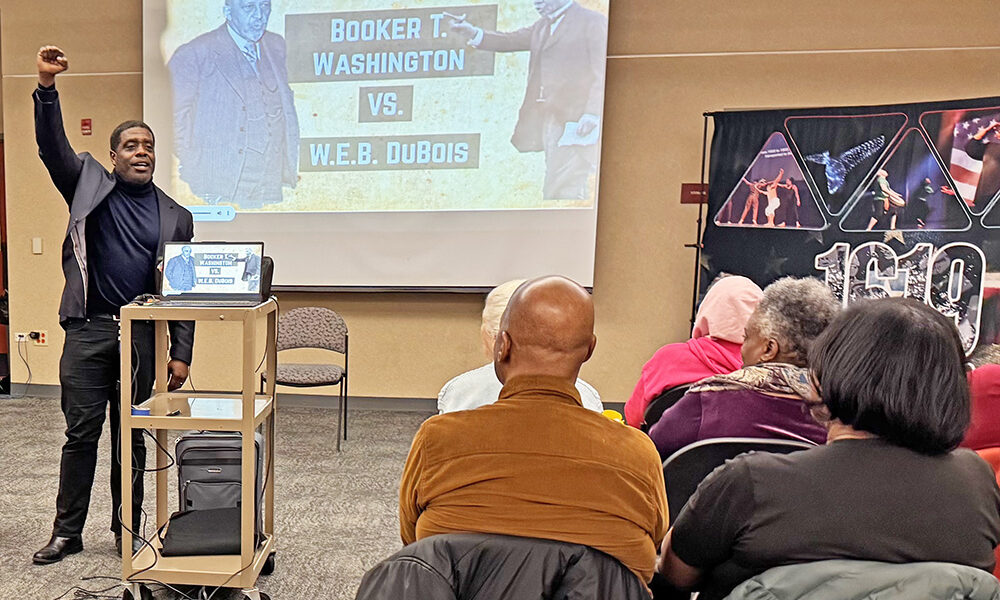


Educator, civic leader, playwright, minister, actor, and family man — Ted Williams III plays many roles in life.
On Feb. 18 his ability to use all of his talents in his one-man signature work, “1619: The Journey of a People,” mesmerized the audience at the Helen Wilson Meeting Room at the Flossmoor Library.
From single-handedly setting up his props, music, and visuals to channeling historical figures such as Booker T. Washington and Dr. Martin Luther King Jr., Williams captured the audience’s attention for more than 90 minutes.

Part documentary, part musical, part spoken word, “1619: The Journey of a People,” is a sweeping call-to-consciousness project that was born more than seven years ago when the City Colleges of Chicago political science professor realized that 2019 would mark the 400th anniversary of the arrival of the first Africans in colonial America.
There are several versions of his work, and the longer form of “1619” is often staged with dancers, musicians, and other actors, but this was his shorter version, which still delivered eureka moments to the audience, who hung on every word of his message and afterward engaged in lively discussion about African American history and social justice.

“On Aug. 20, 1619, 20 enslaved Africans arrived at Port Comfort [now Hampton, Virginia] three months before settlers arrived on the Mayflower at the tip of Cape Cod [now Provincetown, Massachusetts].” Williams said.
“They [Africans] were brought to the Americas as human manpower to be used to strengthen a workforce of indentured Europeans and Native Americans, all of whom had been brought there to build an economy that would become the greatest in the world.”

In the end, approximately 400,000 enslaved Africans were shipped directly to North America until the slave trade was abolished in 1866. Eventually, the Europeans would be freed and the Native Americans annihilated, but the Africans would remain slaves for almost 250 years after they landed on that Virginia peninsula.
It was a situation that shaped the lives of the Africans who remained in this new country, and Williams used all his talents and a few personal stories to showcase their history in America from the 1619 landing through slavery, Reconstruction, Jim Crow, the Civil Rights Movement, their place in contemporary America and beyond.
Since its debut, “1619: The Journey of a People” musical has been presented at schools, civic centers, cultural centers, and other venues dozens of times. It has received accolades wherever it was performed.

Williams’ idea is to produce artistic content that uses historical facts to educate and engage people about issues such as social justice and equality, literally making it a vehicle for change.
“I’m very proud of our work because I believe that Black history is American history,” Williams said.
Williams lives on the Southwest Side of Chicago with this wife, Roslyn, and his children Gabrielle, Amaris, and Theodore IV.
Ted Williams III can be contacted about future performances at [email protected].


