


Before the conversation really begins, he makes one small correction.
“It’s Bernie.”
You had just called him Dr. Heilicser.
You had read the old story about him. You knew what he meant to this area.
An emergency physician. A longtime EMS leader. A volunteer firefighter in three towns.
But on the phone, he is gentle about it.
“It’s Bernie.”
After more than four decades shaping emergency care in the South Suburbs, Bernie Heilicser stepped away from full-time emergency department shifts on Dec. 31.
It is a milestone he is still adjusting to.
“That’s why it’s referred to as kind of a retirement,” he says. “The workload’s not as intense.”
Not a full stop.
Just a shift.
For 41 years, Bernie served as medical director for South Cook County EMS, helping shape how paramedics across the region are trained and how they respond on someone’s worst day.
If you live in the South Suburbs, you’ve felt his influence in ways you probably never noticed.

Generations of paramedics learned under his watch. Protocols were written, rewritten and refined with his input. Firehouses in University Park, Mokena and Flossmoor came to know him not as a distant administrator, but as someone who showed up.
He never framed it as leadership. He framed it as responsibility.
He remains board-certified in emergency medicine. He is still on staff at Ingalls Memorial Hospital.
“And here comes the obnoxious embellishment,” he says after being asked with a laugh.
For decades, Bernie has quietly worn more hats than most people realize. A board-certified emergency medicine physician. Forty-one years as medical director for South Cook County EMS. Now associate director, mentoring his successor.
For 33 years, he has led the medical ethics program at Ingalls Memorial Hospital. He is still on staff. Still answering questions. Still teaching. Still a volunteer firefighter.
None of it, he insists, makes him special.
But taken together, it tells the story of a career built almost entirely around service.
His version of slowing down still involves mentoring his successor and answering questions when needed.
“It’ll be weird,” he says. “But it gives my wife and I more opportunity to do stuff.”
Then, almost as an aside, he adds something else.
“I’ve got to say the most praise possible for my wife, for tolerating me.”
He and Marcia married the day before his graduation from Des Moines University College of Medicine. Nearly 50 years later, they have three sons, Micah, Seth and Jacob, and seven grandchildren.
“We’re very blessed,” he says. “We do a lot of babysitting.”
That instinct to show up started early.
Bernie grew up in Brooklyn, the kind of kid who ran toward sirens instead of away from them.
You can still hear a trace of Brooklyn in his voice.
“Whenever I saw an ambulance or a fire engine going down the block, I ran after it,” he says. “I was like a little piggy chasing a fire engine.”
His path to medicine was not linear.
He went to college on a football scholarship.
“With all due respect,” he says, laughing, “I was a dumb s— in high school. My grades weren’t good.”
Football got him in.
Studying kept him there.
After college, he worked as a social worker in Brooklyn. He earned a master’s degree in neuroanatomy, then taught at the University of Pennsylvania before heading to medical school.
During his internship in Detroit, he realized something.
“Every time there was something going on in the emergency department, I found myself running ahead of everybody to get there,” he says. “I loved the excitement. I loved the unpredictability.”
Emergency medicine fit.
“Or,” he adds with a laugh, “we make the s— up as we go.”
Trying new techniques. New approaches. Doing whatever might save a life.
He laughs. But underneath the humor is something real. There is no script in chaos. Only training, instinct, and the people you trust beside you.

Family Care Center in Flossmoor in 2017. Assisting him is nurse Marcus Larrieu of
Flossmoor. (Chronicle file photo)
While working in Virginia, he became a volunteer firefighter in Blacksburg.
When he and Marcia moved to the South Suburbs in the late 1970s, he introduced himself to the fire chief in University Park and asked to volunteer. He later served in Mokena.
For roughly 40 years now, he has been a volunteer firefighter in Flossmoor.
Ask him what stands out over a career that long, and he pauses.
“The answer’s so obvious I didn’t think of it,” he says.
Then he mentions two places.
Louisiana.
Haiti.
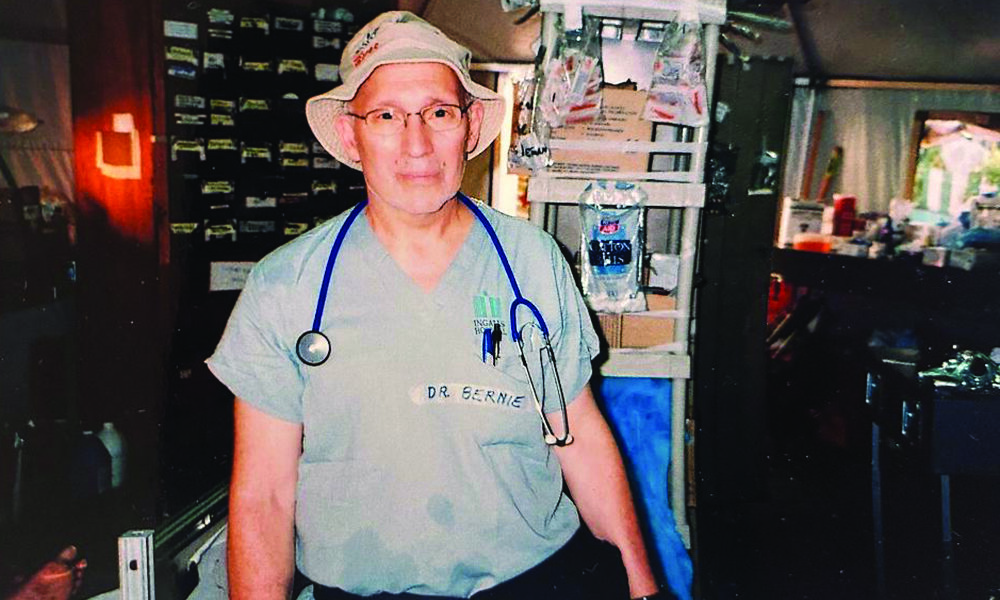
In Baton Rouge after Hurricane Katrina, Bernie worked in what had become a massive triage center at the LSU basketball arena, as helicopters, buses and pickup trucks brought in patients from New Orleans.
“However they could get there,” he says. “We were triaging them, treating the critical ones, and sending others all over the country.”
He stayed 10 days. When it was over, and the flow of patients stopped, he flew home on a C-130.
“It felt like we did something good,” he says.
Haiti was different.
Nothing in decades of emergency medicine prepared him for what he saw in Port-au-Prince.
The hospital had collapsed. Care happened in military tents. A nearby nursing school fell during final exams. He remembers being told that roughly 180 students died there.
“These people had nothing to start with, and they lost their nothing,” he says.
Yet what stays with him most is not the devastation.
“They could not have been more polite.”
Patients removed their shoes before climbing onto cots. Parents dressed children in their Sunday best before bringing children for vaccinations.
“They were just beautiful people,” he says.
He remembers a baby brought in nearly in cardiac arrest. The team worked aggressively. When the baby finally cried, everyone in the tent did too.
When he returned home from Haiti, walking through a store felt surreal.
“Aisles and aisles of choices,” he says. “And they had nothing.”
Before leaving Port-au-Prince, he gave away everything he had brought with him except the clothes on his back.
Not for recognition.
Just a small gesture that felt right to all of them.
He carries a quote with him, one he learned from a paramedic student years ago and now repeats at graduations.
“To the world, you may be one person,” he says. “But to one person, you may be the world.”
He says it got him through Haiti.
It still does.
Ask him how he wants to be remembered, and he doesn’t answer directly.
“That’s for them to answer,” he says.
Instead, he talks about privilege.
“I’ve been so fortunate,” he says. “The privilege of being involved in that field for so long.
“Working with wonderful people.”
Retirement, or whatever version of it this becomes, means fewer overnight shifts and more time with Marcia.
More time with grandchildren.
Maybe fewer sirens.
But the instinct to show up is still there.
And if you run into him around town, don’t overthink it.
Just call him Bernie.


