

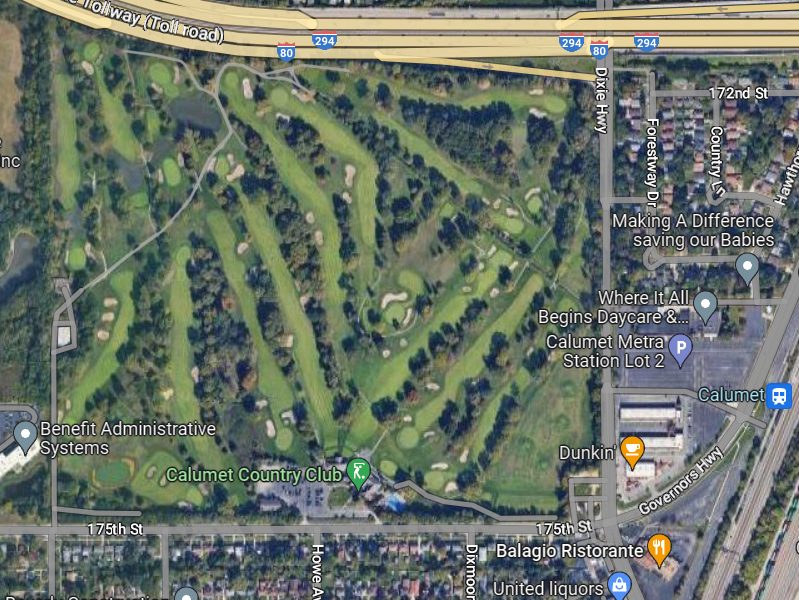


The issue of Calumet Country Club redevelopment is back.
At the Hazel Crest village board’s administrative meeting Tuesday, Oct. 14, Kyle Schott, vice president of real estate development for Ryan Companies, gave a presentation to introduce the company to the board and community and to offer a description of its approach to redeveloping Calumet Country Club, which it is in the process of purchasing.
For the past two years, Calumet Country Club in Hazel Crest has been a place of golf rather than controversy after two efforts to redevelop the property from 2021 to 2023 failed.
“I’m here today to first introduce myself and Ryan Companies and ultimately start the communication process to redevelop the site,” he said. “We would like to start a transparent dialogue with the community on the site redevelopment.”

Schott described Ryan as a multifaceted company with nearly 90 years of experience that has the capability to provide development, architecture, engineering, capital and real estate management services.
He said one of the first steps in the process would be to commission a third party to do a market study that would help determine the best use for the country club property.
Other studies would follow, including examination of traffic and environmental impact. The company plans to hold community meetings in order to understand residents’ vision for the site.
He stressed the importance of finding alignment between community goals, potential users and capital finance.
“Because Ryan wants something doesn’t necessarily mean the community wants that. Just because the community wants something doesn’t necessarily mean that the capital behind that sees that as a proper investment,” he said. “So we have to find out what everyone wants and see if there’s alignment there.”
When pressed by Trustee Merle Kimbrough-Huckabee, Schott said the apparent best use for the site would be industrial, although he said other uses might also prove viable.
Companies headed by Arizona real estate developer Walt Brown purchased the country club in 2021. At the time, the site was in Homewood. Brown attempted to get necessary zoning and incentives from Homewood to create a warehouse complex on the site.
After the Homewood board declined to approve the plan, Brown successfully disconnected the property from the village and it subsequently was annexed by Hazel Crest.
Brown then engaged Catalyst Consulting to create a redevelopment plan. The firm held a number of public meetings during the fall of 2022 and spring of 2023, but the effort fizzled out.

Several members of South Suburbs for Greenspace attended the Oct. 14 meeting. The group formed in 2021 to oppose the first redevelopment effort, and its reaction to Ryan’s presentation indicated its stance has not changed.
David Sacks addressed the Hazel Crest board following Schott’s presentation, but he directed his comments to the Ryan representatives in the audience.
“With all due respect, we don’t care how impressive your company is or how nice you are. This is a project the community does not want,” he said. “Our community does not want an industrial development near all of our homes, to be built in the heart of three different residential communities.”
He noted that for residents of Hazel Crest, East Hazel Crest and Homewood who live near the country club, their largest investment often is their homes.
“An enormous industrial development built across the street from a neighborhood obliterates property values,” he said.
He said the green space currently helps counteract air pollution from nearby Chicago and Northwest Indiana industrial areas.
SSG founder Liz Varmecky said Ryan’s early proposals seem similar to the previous efforts the group opposed.
“Same story, different face and different village,” she said. “Their purchase of the property is conditional upon the rezoning, again reminiscent of Walt Brown’s purchase of the property, where he claimed that Homewood officials assured him that he would receive the industrial zoning and a TIF but didn’t account for the community.”
She said SSG is prepared to continue its opposition to industrial uses on the property.


