


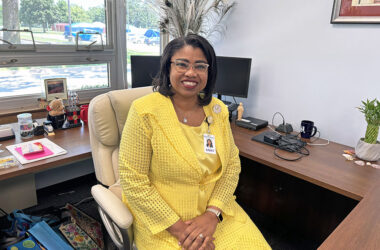
Christine Suddreth comes from the nonprofit sector. Jennel Hooper represents the business community. Each knows it will take both sectors to address the social determinants of health impacting the communities they serve.
The Centers for Disease Control describe social determinants of health as “the non-medical factors that influence health outcomes. They are the conditions in which people are born, grow, work, live, age and the wider set of forces and systems shaping the conditions of daily life.”

Those conditions can include things such as racism, climate, economic policies and social policies, according to the World Health Organization.
Suddreth, Hooper and members of the community will come together from 8 a.m. to noon on Friday, Oct. 17 at this year’s Social Determinants of Health panel discussion event at Moraine Valley Community College.
Registration is required, but the event is free as is the parking, said Hooper, executive director of the Chicago Southland Chamber of Commerce, the event’s organizer. A continental breakfast will be served and attendees will have the opportunity to network.
Now in its fourth year, the event will feature three panel discussions. The topics are “Housing and Economic Stability” facilitated by Jay Readey, president and CEO of Metro Alliance; “Education and Social Support Networks” led by Steve Pappageorge, vice president of workforce strategies and external affairs at Moraine Valley Community College and “Digital Access” led by Hooper.
Panelists for the Housing and Economic Status panel are Michael Antoniades, president of UChicago Medicine-Ingalls Memorial Hospital; Dr. Kiran Joshi, chief operating office for the Cook County Department of Public Health and Karen Woods, director of Strategic Initiatives for Neighborhood Housing Services of Chicago.
Panelists for the Education and Social Support Network are Dr. Lynette Stokes, president of South Suburban College; Lauren Finnegan, director of Behavioral Health at Metropolitan Family Services and Craig Schmidt, executive director, School of Extended Learning at Governors State University.
Panelists for the Digital Access panel are Alicia Ross, Community Engagement Manager, Illinois DCEO; Kyla Williams-Tate, director of Digital Equity for the Cook County Office of the President and Christian Taylor, director of Digital Equity for the City of Chicago.
“Social determinants of health such as access to education, housing, transportation and healthcare are economic determinants. They are powerful drivers of regional economic performance and determine whether the economy grows sustainably,” Hooper said. “When residents have stable living conditions and opportunities to thrive, businesses benefit from a more reliable and productive workforce, reduced healthcare costs, and stronger talent retention.“
Suddreth, manager of community relations at Pathlights, shared how the event got its start. Pathlights submitted a proposal to the Chicago Southland Chamber of Commerce several years ago for a social determinants of health event. They thought it would be a good partnership, she said. The chamber accepted the proposal and the first event was a huge success, she said.
“We looked at the human condition and what would make someone thrive in their community or hold them back from succeeding,” Suddreth said of that first event. “We had a lot of buy-in from the community and from legislators. They understood the value of uplifting communities.”
Pathlights is a nonprofit that offers programs, services and resources to help seniors navigate aging and “live with independence and dignity in the community.”
Suddreth and Hooper are hoping that this year’s event will be just as successful.
“Hosting a Social Determinants of Health Conference elevates our chamber as a thought leader beyond traditional business advocacy,” Hooper said. “At the Chicago Southland Chamber, we understand that the health of our economy is directly tied to the health of the people. The social conditions that shape daily life are not just community issues, they are business issues as well.
“Businesses play a key role in community well-being and collaboration drives solutions. Addressing these determinants promotes economic inclusion, expands the local consumer base, and enhances the region’s appeal for investment.”
Suddreth agrees.
“Healthy businesses as a whole lead to healthy communities,” Suddreth said.
With social determinants of health being in the news more than ever, she said she sees people are “starting to connect the dots,” at community meetings when it comes to funding.
“People are learning that they have a voice,” Suddreth said.
Everything is connected when it comes to social determinants of health.
Suddreth gave an example of how building a high tech facility could affect a community. It might seem like a positive step because it could create jobs. But what if the residents didn’t have digital access to apply for a job or the education needed to get a job, she said. Or transportation could be an issue. How do you get to work if you don’t have a car and there’s no public transportation? These are real life issues that many people face.
“How do you make sure that when your business goes into a community that you can be a part of a system that provides transportation so that people can get to and from work and provide services to help them lead healthy lives,” Suddreth said.
Hooper shared a digital access example. What happens to people who aren’t tech savvy or don’t have access to digital devices? For example, some seniors who aren’t tech savvy may not be able to access or use online medical sites such as MyChart to reach their doctors, make appointments or see test results.
“Digital access and inclusion isn’t just a social priority, it’s an economic one. Digital inequities can hold back entire communities, which limits participation in the economy,” Hooper said. “Customers and commerce are increasingly online. Access and inclusion drives regional growth by helping more residents become earners, spenders and innovators and fuels a stronger economy.”
In addition to the panels, there will be vendors onsite and information about resources.
“I encourage people to come out. I encourage students to come out. This is the kind of thing you can’t always learn in the classroom,” Suddreth said.
If you want to go
Social Determinants of Health, “Connecting the Dots,” will be held from 8 a.m. to noon on Oct. 17 at Moraine Valley Community College, 9000 W. College Parkway, Palos Hills, IL 60465. The event will be held in the M Building.
Here’s the link to register or visit the Chicago Southland Chamber of Commerce’s website at www.chicagosouthlandchamber.com.
Event sponsors include Comcast Business, Governors State University, UChicago Medicine Ingalls Memorial and Metropolitan Family Services Southwest.


