



“If walls could talk” is a familiar phrase that suggests buildings bear silent witness to the lives unfolding within them. In Homewood, thanks to local history advocates and volunteers, the walls of the 1891 Dorband-Howe House at 2305 W. 183rd Street are telling the vibrant story of Homewood’s past to anyone who steps across its threshold.
Spiffed up and proud to have received a Blue Ribbon Beautification award this year, the Victorian-era structure has become home to the Homewood Historical Society (HHS) Museum and a repository for the village’s history.
![It took museum volunteer Chuck Hecht four years to bring back the garden and landscaping around the 1891 Christian Dorband-Charles Albee Howe house that houses the Homewood Historical Society [HHS]. Hecht’s efforts paid off: This year the Dorband-Howe property was awarded one of five “Blue Ribbon Beautification Awards” from the Homewood Beautification Committee. (All photos by Karen Torme Olson)](https://www.hfchronicle.com/wp-content/uploads/2025/09/HHS-gardeners-782550007-gardener-1_web.jpg)
The building was nearly lost to demolition, but through the determined efforts of HHS co-founder Elaine Egdorf and fellow preservationists, it received landmark status and was spared. Today, its rooms hold not just bricks and mortar, but the genealogy of Homewood: period photographs, well-worn furniture, delicate clothing, and thousands of documents and artifacts charting the community’s journey.
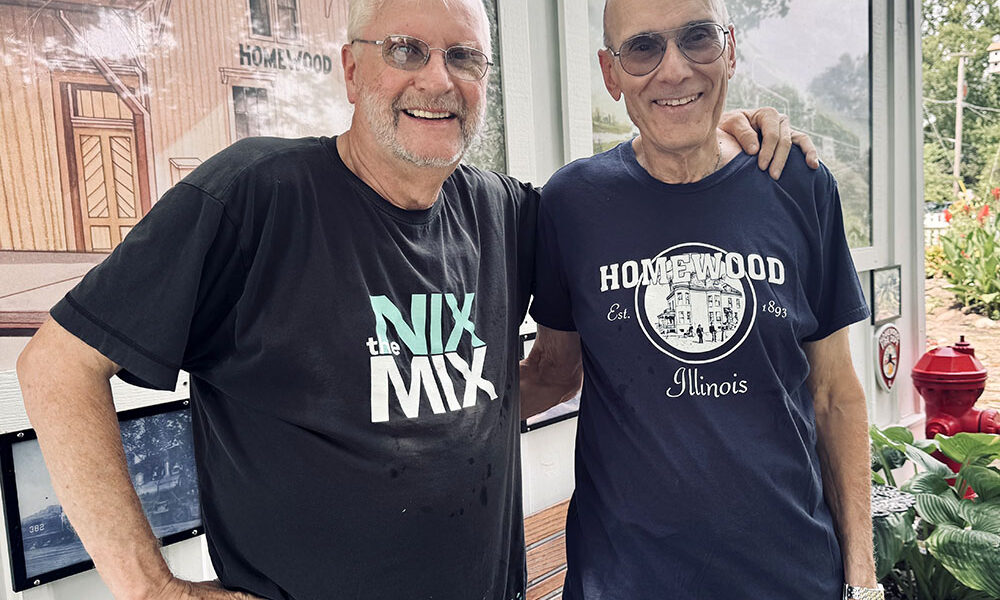
While the efforts of Egdorf and others saved the building from the wrecking ball, Charles “Chuck” Hecht of Crete and Ken Biagi of Homewood have been giving their time and craftsmanship to keeping the building sound, which will insure that both the collections and the house remain vibrant parts of the village.
Though he now lives in Crete, Hecht grew up in Homewood, and his connection to the village runs back to 1851 when his great-great-grandfather, Conrad Hecht, and his family arrived in Homewood from Germany. However, Hecht said he grew up knowing very little about his lineage. “My dad never talked about the family,” Hecht recalled. “I didn’t even know who my grandmother was — she died when I was 12.”

Hecht’s passion for genealogy was sparked later in life through a co-worker, who led him to the very place he now helps preserve: the HHS museum. It was there that Hecht began uncovering not only his family’s past but also Homewood’s broader story. Over time, he found himself drawn into the effort to revive the Dorband-Howe House and its grounds.
Handy with tools and dedicated to the cause, Hecht has spent four years patiently bringing the once-overgrown gardens back to life. On any given day, he can be found watering the grounds, mending broken fixtures, or tackling the endless challenges of keeping a 19th-century house intact. “I’m pretty handy,” he says simply. “If something needs fixing, I fix it.”
![It [the garden] always seems to need water,” Hecht said, and he devotes several days each week to caring for that and the everything else related to the structure.](https://www.hfchronicle.com/wp-content/uploads/2025/09/HHS-gardeners-782552038-gardener-7_web.jpg)
Alongside Hecht stands fellow volunteer Ken Biagi, whose interest in history was kindled at a presentation about Blue Island, his mother’s hometown. Soon after, Biagi joined the HHS, first working on the finance committee but eventually throwing himself into hands-on preservation.
Now, every Saturday finds him at the Dorband-Howe House, brush or hammer in hand. “It’s an old house and there’s always something that needs fixing or painting,” he said. Biagi’s dedication and skills have made him indispensable in keeping the property — and its stories — alive.

The Dorband-Howe House itself is imbued with stories. Constructed from bricks stamped “Homewood,” the house bears the signature of the Gottschalk Brick and Tile Works, which flourished in Homewood in the late 19th and early 20th centuries. This distinctive mark and intervention of passionate HHS leaders like Egdorf and the late Homewood historian James R. Wright further secured its preservation by helping the house achieve landmark status.
What began with just a handful of artifacts has grown into an extensive and carefully catalogued collection, stewarded by volunteers who recognize the building as a rare, tangible link to the town’s origins.
Together, Hecht and Biagi embody the heart of the HHS’s mission: preserving not just objects, but the history of Homewood itself. Their work uncovers the legacy of the society’s founders and ensures that future generations not only will learn about the town’s past, but also walk through it, room by room, garden by garden.

by-23-inch-wide cast-iron bell that was used
at Homewood’s first public school, which
opened in 1800. It was donated to the HHS by
Gina and John Inwood, whose late aunt
wanted the bell to go back to Homewood after
her death.
If walls could talk, the Dorband-Howe House would whisper about its near destruction, speak proudly of its rescuers, and tell of quiet afternoons, where volunteers paint walls and reminisce. Thanks to the dedication of Homewood’s history keepers, those walls don’t need to whisper anymore — they are speaking their story loud and clear.
Note: The HHS Museum is open to the public from 1 to 3 p.m. every Saturday. There is no charge for admission.
For more information, visit homewoodhistoricalsociety.wordpress.com.


