

If you’ve ever wondered what a bald cypress has in common with your hair after a long, sweaty day, Tristan Shaw has an answer.
“It holds water,” he said. “That’s what plants do, that’s what trees do. And we’re out here doing everything we can to get water off our property as fast as possible. It makes no sense.”
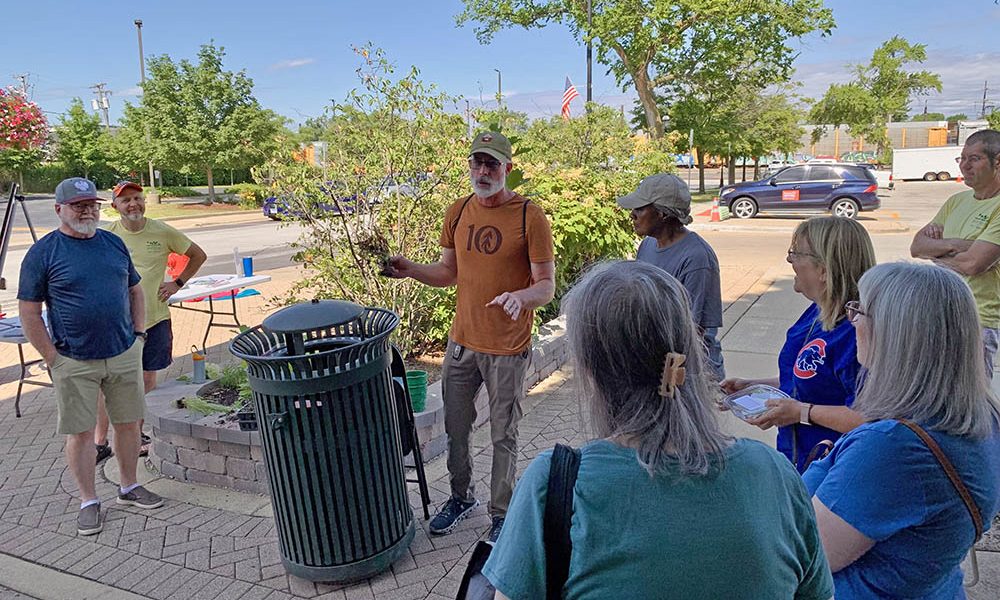
Shaw, who runs Possibility Place Nursery in Monee, spoke at Saturday, July 12, at Homewood’s Green Thumb Saturday event. A free workshop focused on native tree planting, held at Homewood’s Village Hall on Chestnut Road.
The event offered more than gardening tips; it was a call to action.
“Every property owner has a role to play,” Shaw said. “What you plant matters for stormwater, for pollinators, for biodiversity, and native plants do real work.”

Green Thumb Saturday is a seasonal series led by the Homewood Tree Committee.
Tony Greep, who helped spearhead the event and is a Master Gardener through the University Of Illinois Extension, said the series has been offered for over a decade.
“This runs every second Saturday through the growing season,” Greep said. “With the village’s support, we’ve been doing this for over 10 years. It’s about learning something new and getting a little dirt under your nails.”
Participants followed Shaw outside to examine native plants up close. He held up examples of trees grown in different containers and pointed out the difference between healthy and struggling root systems. One tree potted in a mesh grow bag, showed signs of stress, another grown in a biodegradable container, had bright white roots and structure.
“These are designed to go back to the earth,” Shaw said. “And the plant knows what to do.”
He also held up a mass-produced hydrangea, big flowers with no pollinators.
“It’s a clone,” he said. “Every single one you see in yards like this is genetically the same plant. No nectar, no seed, nothing to support life.” Shaw added, “It looks like it’s helping, but it’s not.”
“Ask where it was grown,” Shaw said. “Look at the roots, if it’s all flowers and no life around it, that’s a clue.” Many ornamentals, he said, may look nice but don’t support insects or birds.
“If you walk past a landscape and it’s not buzzing, that should tell you something,” he said. “We’ve got a new norm, and it’s not working.”
He meant it literally. No sound, no insects, no pollinators, that’s the warning.
Shaw emphasized that similar trees often adapt better, require less maintenance, and come with a lower environmental cost.
“You’re planting a long-lived organism,” he said. “It might be here for 50 or 100 years from now. But it needs to start with the right roots.”


Shaw brought free trees including chin oaks, burr oaks, swamp white oaks and white oaks for attendees to take home. He encouraged people to take extra for neighbors or plant them in any available space.
“Oaks are keystone species,” he said. “They support more life than any other trees in our region. If you want to make a difference, start with an oak.”
Greep agreed: “Most land in town is private. That’s yards. If everyone does a little, maybe adding a rain garden, no more spraying chemicals, adding native plants, it really adds up.”
Greep converted his own yard five years ago, “I used to have a lake in my backyard every time it rained,” he said. “Now? The plants drink it up.”
He suggested aiming for a mix of 80% native plants, 20% ornamental.
“You can still have what you like, but with balance that gives back to the environment.”
Much of that thinking, he said, lines up with the work of entomologist Douglas Tallamy, who encourages homeowners to treat their yards as part of the local ecosystem.
“You don’t have to wait on the forest preserve or the village,” Greep said. “Start with what you can control.”


