

Social workers, nonprofit organization members, community activists, politicians and public servants from the South Suburbs and the South Side of Chicago spoke about gun violence at Prairie State College’s Conference Center on Tuesday, June 17.
The conference was From Violence to Action: Building Safer Communities Together. Speakers shared their personal experiences with gun violence and discussed preventive solutions that community members and government officials could enact.
Many speakers and audience members wore orange shirts for Wear Orange Day, an annual gun violence awareness campaign observed on the first Friday in June. A three-panel poster with the photos and names of 58 people who died from gun violence was displayed outside the conference rooms.

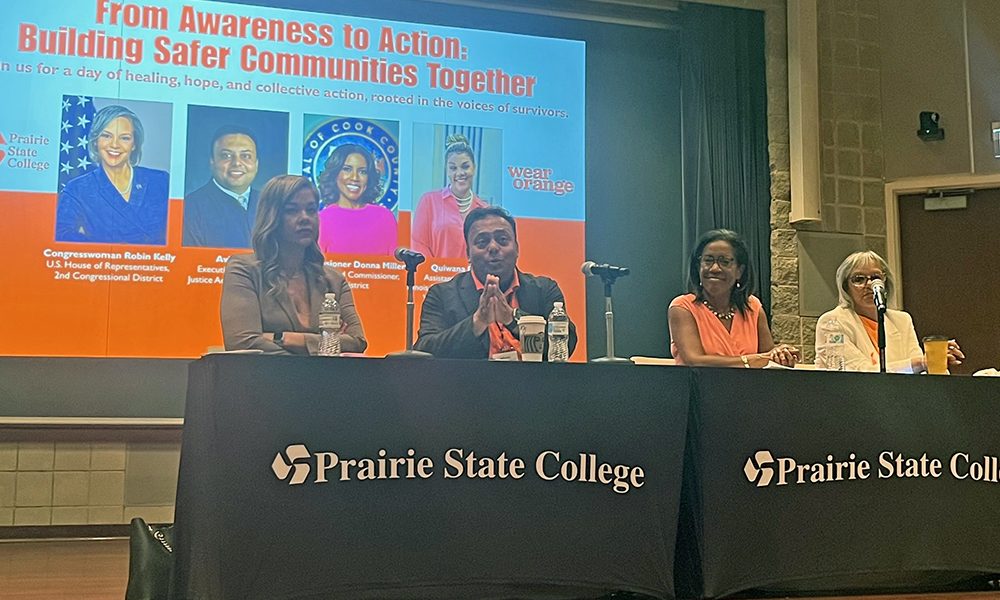
In the first discussion panel, U.S. Rep. Robin Kelly (D-Ill.), Cook County’s Justice Advisory Council Executive Director Avik Das, Illinois Department of Homeland Security Office of Firearm Violence Prevention Assistant Secretary Quiwana Bell and Cook County Commissioner Donna Miller spoke on stage in the Barnes & Noble Auditorium.
Kelly said that she voted for the Bipartisan Safer Communities Act, a law that passed in 2023.
The Bipartisan Safer Communities Act was the first federal gun control legislation enacted in the previous two decades, tightening restrictions on federal gun license and on straw purchases, which is when someone illegally buys a firearm for another person.
Kelly said the next step is for Congress to pass the Break the Cycle of Violence Act, a bill that would provide federal grants to communities for gun violence prevention programs, adding that the justice system already spends hundreds of thousands of dollars after one homicide occurs.
“So, we’re spending lots of money that way. We need to spend more money on prevention,” Kelly said.

In the second panel, the speakers were Illinois State Board of Education Chief of Staff Kimako Patterson, author Kisia L. Coleman, University of Chicago Medicine’s Violence Recovery Program co-founder Dwayne Johnson and Crime Lab and Education Lam Research Manager Heather Bland.
Patterson asked the audience why most shootings happen, encouraging attendees to yell out their answers.
“Anger,” “frustration,” “unresolved trauma,” “poverty” and “easy access to firearms,” different audience members said.
Patterson said that all of the above contribute to gun violence, adding that most shootings aren’t premeditated but are unplanned acts of aggression. She said that’s why she advocates for Illinois social programs designed to help reduce truancy in public schools, thus reducing gun violence.
After a lunch break, the conference moved to the Proven IT Room, a more intimate setting. Among others, Laurence Patterson II from Cook County Commissioner Kisha E. McCaskill’s office, God.Restoring.Order Community Executive Director Jerry Davisel and GoodKids Mad City community activists Carl Williams, his sister Camiella Williams and Reynia Jackson spoke to the group.
Carl gave an emotional speech about losing his 26-year-old son, rapper FBG Duck, to gun violence in 2020 and being formerly incarcerated for a crime he didn’t commit.
“My son was murdered on Aug. 4, and I was released [from prison] on Aug. 11. This kid came to court consistently and came to visit me consistently.” Carl said.
Carl said his grief continues to “linger” and “leave a lasting impact.”
“Some days will feel more unbearable than others,” Carl said. “And I will let myself cry. I will let myself scream.”

Carl said he used to find it important to show how tough he was, but now he wants to be gentler with himself. He concluded the speech with a poem he wrote about trauma and loss.
Next, Camiella and Jackson joined Carl on stage. They explained why GoodKids MadCity, a neighborhood-based peace collective and nonprofit organization in Chicago, was formed in 2017 and how it helps curtail youth violence.
GoodKids MadCity trains Chicago youth in de-escalation techniques and restorative justice in what its flier described as “under-resourced, over-policed and under-protected neighborhoods.”
The peacekeepers meet four nights a week and engage in mediation and conflict negotiation with other Chicago youth before violence occurs.
Organizers said this is an effective strategy because Chicago youth often listen to their peers in the community more than the police or other adults.
“When there’s a fight. They get in there. They break it up,” Camiella said. “Because their peer-to-peer connection is something.”


