

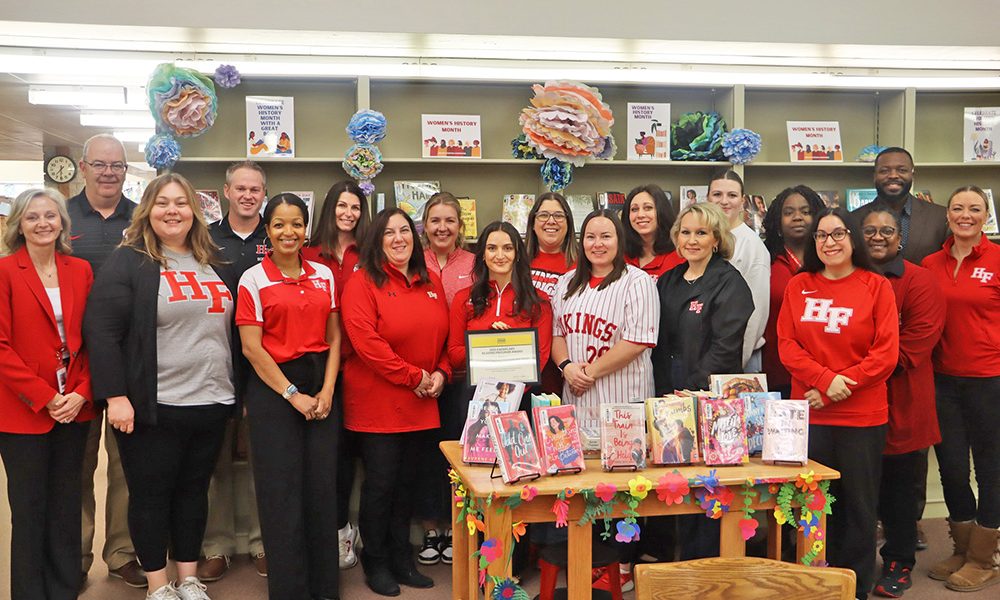
Lauren Freeman, front row in black, is surrounded by reading specialists and teachers who have helped convert the reading program at Homewood-Flossmoor High. The International Literacy Association presented H-F with the Exemplary Reading Program Award. (Provided photo)
Education, Local News

New approaches for reading win H-F national honor

Note: This story is the first part of a three-part series.

A new approach for helping Homewood-Flossmoor High School students improve their reading and comprehension has won the Reading Department an Exemplary Reading Program Award from the International Literacy Association. The honor recognizes outstanding reading and language arts programs across North America and recognizes school staff who demonstrate excellence in reading and literacy programs.

“It’s an honor to be recognized. It’s been a lot of hard work,” said Lauren Freeman, Reading Department lead.

For years, H-F had a specially designated reading class for students whose test scores showed they needed help to improve their reading. Freeman proposed a new method. She recognized students were having difficulty not just with reading but with reading and comprehending school texts.

For a year’s pilot program, Freeman and other reading specialists were moved into the U.S. History and World History classrooms to work alongside the classroom teacher.

Lauren Freeman, front row in black, is surrounded by reading specialists and teachers who have helped convert the reading program at Homewood-Flossmoor High. The International Literacy Association presented H-F with the Exemplary Reading Program Award. (Provided photo)

Freeman presented her pilot program successes to the District 233 school board and got district policy for a mandated reading program dropped. The Reading Department would still know which students needed help, but the reading specialists would use classroom texts and projects to help students read and comprehend.

H-F’s pivoting away from a designated reading class to one that embeds reading specialists into World History and U.S. History classrooms is in line with a multi-tiered system of support for reading intervention.

“It’s rooted in the neuroscience of how individuals learn to read,” Freeman said. “Reading isn’t an innate process. It requires explicit, systematic and diagnostic instruction to develop essential literacy skills.”

In 2021, Freeman explained to school board members how she recognized students could be discouraged if they lagged behind in their reading skills. And, it was affecting state and national test scores. The reading class approach wasn’t really helping.

“We were putting kids in all these reading classes – freshmen through seniors – based on standardized test scores in reading” but the students weren’t showing real progress in mastering the materials for the core high school courses.

“The reason we chose (those history classes) is because there’s so much reading. It’s a heavy, heavy reading class,” said Jen Rudan, director of Student Supports.

Freeman proposed a reading specialist would offer immediate help tailored to each student’s unique needs around the history topics they were studying.

“Reading stories seems a little easier. It’s the nonfiction reading that has such complex vocabulary,” she said.

The Reading Department today uses a tiered system focusing on students reading at or below an eighth-grade level. Of the 2,700 students at H-F, the Reading Department is assisting between 175 to 200 students. Rudan said that number “is very fluid. Just because you’re in reading intervention this year doesn’t mean you’re here (throughout your H-F career). Once you hit that benchmark, we move you out very quickly.”

Tier 1 uses classroom teachers to work on prevention methods. “That’s as simple as a teacher taking an extra step to prevent a student from struggling. A lot of that happens in the natural teaching process. You hear a student struggling and you rephrase (the question), add a supplemental resource to help them,” Freeman said.

Tier 2 is an intervention strategy. “There are kids who just need a little more time and instruction and strategy to become better readers.” They are in the history classes with a teacher and a reading specialist. The pair has been given training on how to co-teach with “expectations that they are both responsible for teaching the students in the class, affecting the students in the class and planning for the class,” Freeman said.

Tier 3 students have a wider gap in reading. Freeman said they are “students who really need to accelerate their reading so they can be successful with the rigor of high school reading.” In addition to the reading specialists in history classes, these students get between 100 and 200 minutes a week in reading services.

“We’re not changing the level of text for kids. Everyone here at H-F that is being taught to grade level standards is reading at grade level,” Freeman stressed. “What we might be doing is scaffolding text for them or building stairsteps of text for them with the intention of getting them to ultimately read that grade text, but they need that type of text and words together.”

Rudan said what the Reading Department is doing is essential and reinforces H-F’s approach to getting students ready for college, careers and beyond.

Advertisement
Popular stories < 7 days

Newsletter

Meet the Candidates: U.S. Senate

Conversations with the Chronicle