

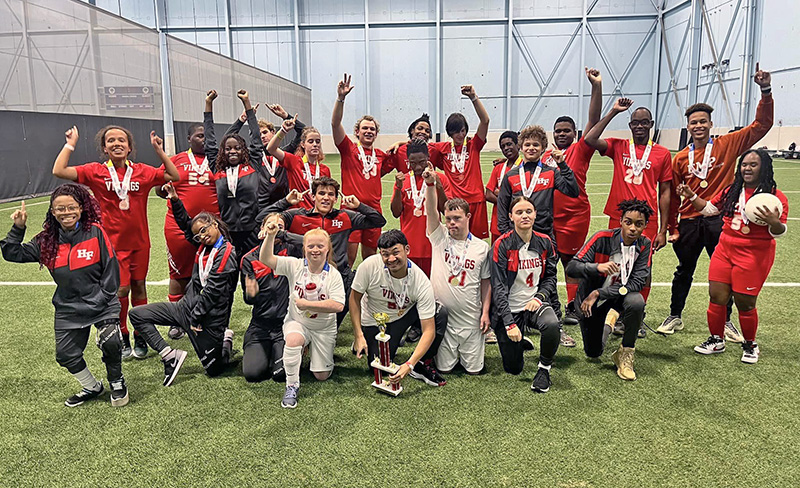
Homewood-Flossmoor High School fielded two teams in the state Special Olympics soccer tournament, and both came home with honors.
The white team won first place and the red team won third place in competition Nov. 2 in Schaumburg. The teams each have eight players who are supported by Unified partners, commonly referred to as peers who are from the general education population. Peers volunteer to work and play with the Special Olympics athletes.
H-F soccer players have captured four titles in three years. The two teams play in different divisions. In 2022, both teams won first place. In 2023 it was the red team that was victorious, and this year the white team took first place.
White team members are Beverly Nwachukwu, Anaya McCoy, Nehemiah Richardson, Quinn McNellis, Faustin Kelly, Gigi Bucci, Marco Agting and Hannah King with peers Evania Regas, Dakota Hoekstra, Eric Baker, Jack Castady and Evan McNeil.
Red team members are Jasmin Harris, Conner Peterson, Alyson Harris, Kamarion Mason, Josh Herman, Auctaveon Wilson, Jeremiah Richardson, Jordan Jones with peers Annelise Latham, Nick Calomino, Joe Neal and Quinn Michel.

Students have been practicing since late August, challenging other neighboring school district teams to matches. At regionals, teams play two games and are assessed on their abilities and paired for state play, explained teacher Katie Nieckula who is the team’s co-coach. Play revolves around the athletes with the peer partners assisting.
“They’ve been playing together for three years. Our seniors now started as sophomores, and to see how much they’ve all grown as players and the relationships they’ve built and how they’ve developed in this program it’s really been awesome to see,” said co-coach Brian Garland.
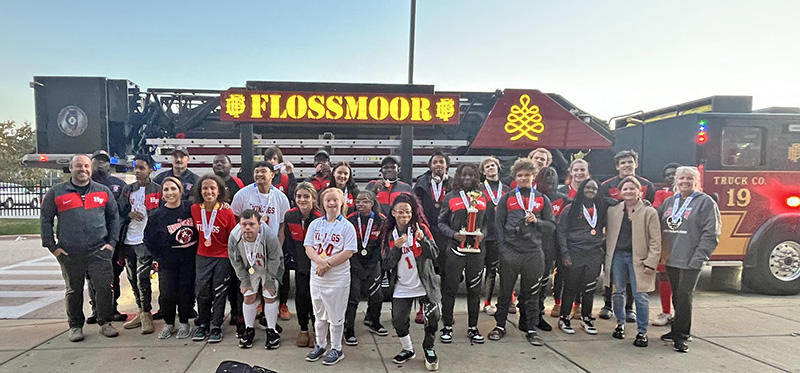
“And how much they care,” Nieckula said. When the bus accompanied by the Flossmoor Fire Department fire engine escort pulled into the H-F lot, there were other Special Olympics athletes waiting to cheer for them. “We love it,” she said.
Special Olympics athletes are required to present Special Olympics paperwork showing they are physically able to compete. Peers go through a background check and a vigorous selection process to be a Unified partner. Peers were selected as upperclassmen in the past, but now freshmen and sophomores are eligible.

“If we can get (peers) in the program earlier, it gives them the opportunity to build those relationships over four years and to grow a lot as a Unified partner,” Garland said. Typically, the peers are so enthusiastic about the program they tell coaches they wish they’d started with the Special Olympics cohort sooner.
Dave Dore, H-F director of Special Education, and Nieckula founded the Special Olympics program at H-F 18 years ago. It has twice been recognized as a National Unified Champion School recognizing H-F’s initiatives for its concerted effort to unify the student body and make certain all students are included as much as possible in every aspect of the school day.
Interaction between special education and general education students goes on throughout the day – in gym class, in the cafeteria at lunch, during passing periods, on special sports teams, through social club activities and designated activities such as Respect Week and Inclusion Week.


