

Recently, I stepped into the H-F field house in the North Building of the high school with a friend who had attended high school nearby but had never seen H-F’s field house.
“Is this the most well-resourced majority-Black high school in the country?” he asked.

After a little informal internet research, I think the answer is yes. There are selective enrollment schools, charter schools and other forms of magnet school around the country with exceptional facilities, programs and results for African-American students. But I couldn’t find an open enrollment, geographically-based high school with the level of resources, offerings and outcomes for a predominantly Black student body that Homewood-Flossmoor Community High School has.
This has salutary effects for students of all backgrounds. The Hispanic population at the high school is growing fast. The white population, consistently shrunk by years of white population loss in Homewood and Flossmoor that mirrored broader patterns in Chicago’s South Side and South Suburbs as a whole, has stabilized. People have realized there was never a good reason to leave, and the reasons to stay or move in get stronger every year.
Populations of Asian-Americans and Muslim-Americans, while small, have grown or remained stable at the high school because the community as a whole is diverse and inviting – and the school systems are as strong as they come, especially for nonwhite students and families.
I have written previously about youth softball and baseball programming as the community’s back porch during warmer months. In upcoming columns, I am excited to write about the academic and artistic excellence of students at the high school. But I am writing this column on the opening weekend of the Illinois High School Association basketball season, and by the time you read this, the season will be in full swing.
Supporting basketball talent
I want to focus on basketball in the H-F community as a story about the cultivation and development of talent in a community, and what it means to the community to support its young people and their endeavors.
This is a subject I know personally and deeply. Since signing up as a coach in the H-F Park District community basketball league 10 years ago, I have participated in basketball as a parent, fan and coach at every level.

Even though my own son has gone on to college to play baseball, I continue to coach as an assistant for middle school players in the Vikings United Feeder basketball program.
What is a feeder program? About 10 years ago, feeder programs started to develop in other school systems to cultivate athletic talent from the “feeder” middle schools that contribute students to their high school.
Homewood-Flossmoor already had long-established feeder programs for football, soccer and cheerleading through Junior Vikings Football and the H-F Soccer Club. But about seven years ago, a previous athletic director and H-F High School coaches for baseball and basketball started a feeder program called Vikings United (to “unite” kids from Parker Junior High in Flossmoor and James Hart School in Homewood, before they attend high school together at H-F).
The best of the best were involved: Excell Hardy and Brian Nussbaum, teammates on the 2004 H-F basketball team that went to the State Championship game, co-founded the program. Vikings United continues with support from the current athletic program and coaches.
Why is this meaningful? Because the development of talent in the Homewood-Flossmoor community has skyrocketed in recent decades, so much so that it has been hard to “keep kids home” as they get to the high school level.
H-F losing top players?
H-F Vikings Basketball has consistently won regional championships and sent kids on to play at numerous colleges, but this year, when the Chicago Sun-Times ranked its preseason top 25 teams, H-F was not among them.
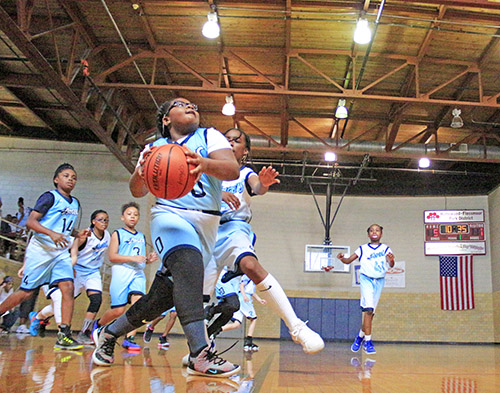
Get this: Nearly a dozen players graced the roster of top 25 teams who had played middle school basketball with Parker Junior High or Vikings United. The top 3 schools alone – Simeon, St. Rita and Kenwood – could yield a starting five of former H-F resident players, some of whom had even suited up for the H-F varsity in previous years.
Marian Catholic, Hillcrest and Bloom were all among the Top 25, so by the time you read this, new head coach Jamere Dismukes (“Coach JD”) will have fielded this year’s H-F squad against some of those local rivalries (all four schools play annually in the Chicago Heights Classic during Thanksgiving week).
My own view is that his talents as a coach and the surprising persistence of talent at H-F, even after a number of high-profile departures, will lead to H-F being ranked in that Top 25 sooner rather than later.
ut with 10% or more of the Top 50 players in the Chicago region having grown up in Homewood and Flossmoor, it is unmistakable that basketball talent is developing here unlike anywhere else in the region.
Think about it: Homewood-Flossmoor an upwardly mobile, highly educated community with a high number of African-American middle class families, has mothers and fathers who played sports in high school, college and the pros in proportions matched in few other places.
Their kids have family traditions and support systems that prime them for success in many pursuits – including basketball. H-F’s girls teams, even more than the boys, have sent players to college basketball juggernauts like Duke and the University of Illinois.
With community investments in facilities like the field house, the infrastructure is laid to be a girls’ and boys’ basketball powerhouse for a long time to come.
But why the talent leakage? There is no single answer, but with scholarships and increasing name, image and likeness money filtering down to college basketball, it is inevitable that if there is a logjam of talent at the high school level, kids and families will pursue their fortunes where they think playing time and exposure to college programs will be best for them.
Talent will continue to seek opportunities.
Support the H-F Vikings
The H-F community’s goal should be to keep as much talent as possible home in H-F, and cultivate winning programs at all levels so families and players enjoy being a part of success together.
Ultimately, this is where community support comes into play. Come out to support this year’s teams of boys and girls basketball – and other sports – based on your preferences or the children and families you know, because H-F is endeavoring to put high-level teams into competition across the board.
The pandemic caused an artificial decrease in spectator support for sports for the last couple of years, so there is special joy in the possibility that Coach JD and the new basketball staff – and their counterparts on the girls side – can build a new winning tradition that not only keeps talent home but attracts new talent and fan support from our community.
I am consistently using this column to argue that something special is afoot in the H-F community that has not previously existed in many places in America – a predominantly African-American community of choice where people of all backgrounds choose to live because of the strength of opportunities, amenities and relationships.
Sports are a powerful symbol of a community’s health, and if diverse communities are to exist with newfound strength in 21st century America, they need to benefit from collective commitments to widespread support of local efforts.
During this winter that’s predicted to be extra cold and snowy, enjoy the basketball season and come out to support your home teams!
