

Local News

Rainbow in our midst: Our LGBTQ neighbors in the Homewood-Flossmoor community

First things first.

There is no organized gay community in the Homewood-Flossmoor area.

There are no bowling leagues consisting of LGBTQ men, women or teens. There are no gay bars, or shops displaying pink triangles or rainbow flags. Outward signs of gay orientation are common in other parts of the Chicago area, but not here.

Still, our diverse towns are home to a number of LGBTQ people. By and large, they have chosen to live here for the most traditional of reasons. Good schools. Safe streets. Well-built homes at reasonable prices. Access to Chicago. They like the fact that our residents are so well educated, and have such a progressive spirit.

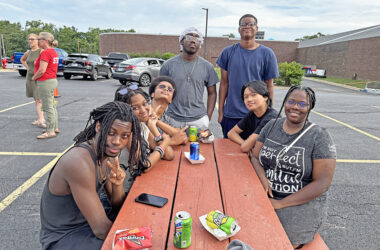
A group of young people head to the Chicago Pride Parade in 2015 in support of LGBTQ members of the community.
(Patty Houlihan/H-F Chronicle)

June is Pride Month. The Homewood-Flossmoor Chronicle wanted to mark this celebration of gender diversity by talking to LGBTQ community members in our midst — our neighbors.

It’s a story that, for us, has been in the works since last June when the Chronicle found scores of smiling young people at the Homewood Metra Station, all decked out in rainbow colors on their way to the Pride Parade in Chicago.  We shared their story about acceptance and love with our readers. And we wanted to hear more.

A year later, the area’s first support program for LGBTQ young people and their parents – Lighthouse — has opened. It is a gathering that meets the third Wednesday of each month at the Community House, 847 Hutchinson Road in Flossmoor. 

A flier for Lighthouse says it is there to provide support for teens and adults who are processing their gender identity and the parents and guardians who love them.

“Lighthouse is a safe, accepting place where individuals are encouraged to come as they are, wherever they are in their journeys,” the flier says. 

The adoptive parents

Andrea Denney and Beth Reich moved from Orland Park to Flossmoor 12 years ago after adopting their oldest daughter, Peyton, who is black. “We didn’t want her to grow up as the only child of color in her school, or community,” Beth said.

They chose Flossmoor for a specific reason: while black students do not do as well as their white counterparts in a “prototypically diverse suburb,” Andrea said, “the outlier was the H-F area, which came closest to socioeconomic parity.”

When they found Western Avenue School, they decided they wanted their infant daughter to go to school there.

“We moved here for the diversity,” Andrea said. “We did this for the kids.”

Beth and Andrea, who met as students at Olivet Nazarene College in Bourbonnais, have been a couple for 28 years and have adopted three African-American children. In 2011, Andrea and Beth were married.

In Flossmoor, they found a community that readily accepted them and their children.

“We have incredible neighbors,” Beth said.

No one has ever questioned the nature of their family, they said. “We’re neighbors,” Andrea said. “We mow our lawns, pay taxes, car pool. We are part of the fabric of this community.”

Beth is a school principal in the Palos area. Andrea is vice president of planning for a retail supply chain management company. Andrea is also on her way to becoming an ordained Presbyterian minister at Chicago Theological Seminary. 

Both come from fundamentalist religious backgrounds and are now members of Flossmoor Community Church. 

“I cannot emphasize how important it has been to us,” Andrea said. Initially, they were reluctant to join an organized church. Andrea talked to Lynn Cheney, the former pastor, who told her that FCC and its congregation would accept them as members.

“We all have a long way to go to learn about the love of God,” Cheney wrote to Andrea in an email.

Andrea is the first openly lesbian elder at FCC.  She is also a youth group leader.

Their children — Peyton, 13; Bennett, 11; and Emerson, 8 – are on numerous sports teams, and their parents are among hundreds in Homewood and Flossmoor who juggle practices and games all year long. Peyton, a Parker Junior High School student, recently competed in the state track finals. She also plays softball and soccer. Bennett plays baseball — 110 games a year — as part of Illinois Axis, a travelling team. Emerson plays softball and soccer. Most weekends during the summer will find them on the road, going to games and cheering on the kids and their teammates.

Beth and Andrea were asked if there is anything that might improve their lives.

There is, they said, “a lack of families that look like us. We all need to be around families that look like us.”

Still, they are very happy to live in the H-F area.

“We have a wonderful life,” Beth said. ”We are privileged to live where we live.”

Mother of a gay teenager

Lighthouse, the support center for LGBTQ young people and their parents, has three founders — Stephanie Wright, Valerie Litchfield and Phillip Barker.

Stephanie and Valerie are both parents of gay sons. Stephanie’s son, Alex, came out when he was in eighth grade. He is now 17. She also has an older son, who is 19, and straight.

She does not notice any differences in the ways her two sons have grown up.

“They are both having a pretty identical experience,” she says.

Asked about any differences because Alex is gay, she says, “This is just sexuality. We are treating them both the same.”

Alex has had no negative experiences at H-F High School, she said. Other teens are very accepting. So is his brother.

“He has all kinds of friends, both straight and gay. Kids like to talk to him. He is very confident.”

When their son came out, the Wrights told their immediate family. Beyond that, there was no announcement to the rest of the world.

“People can figure it out on their own,” she said. “It’s a non-issue.”

Stephanie said she tells Alex that he’s not special because he’s gay.

“I tell him, ‘You are special because of all the things you are. Because you’re smart, and musical, and so much else.’”

John Litchfield, Valerie’s son, came out several years ago. John now lives in Chicago but remains close to the H-F area; he is a youth chaplain at Flossmoor Community Church.

Stephanie said she sought advice from Valerie, who has been something of a mentor.

“I just wanted to link up with someone with a gay son who was OK,” she said. “I asked (Valerie) a lot of questions. She said to me, ‘Someday someone will come up to me with the same questions.’ And that has happened.”

Asked about Alex’s coming out, she said the memory is one she holds close to her heart. But it is private and she does not share the details. 

“It was like having him re-born,” she said with a smile. “We celebrate the day every year. I can remember everything about the day.”

To her, the only thing missing is a place where young people can meet to talk about this part of their lives. Seeing a need in the South Suburbs, Stephanie and her fellow organizers started Lighthouse.

“There are kids who are struggling in our community,” she said.

Stephanie and her family moved to Flossmoor 13 years ago. From their first day in the community, people came forward with cookies, restaurant menus and offers of help.

“They wanted to share,” she said.

It makes a difference when you raise a gay son in the H-F community, she said.

“Living in a town like this, you just raise your sons. Not your gay son or your straight son. Nobody cares. You can just be.”

The business owner

Drew Mohon and his partner Ernie moved to Homewood in 2008. They previously lived in Chicago but Drew – who grew up in Ohio farm country – was never able to adjust to the city’s “pace, energy and noise.” He wanted to be closer to nature again.

They looked for a house all around the Chicago area, including Northwest Indiana. Finally, they discovered the Homewood-Flossmoor area with its “really great houses for good prices.” They originally wanted to buy a mid-century house but settled on a 100-year-old Prairie-style classic, nestled in the woods near Butterfield Creek in Homewood.

Coming from a conservative community in Ohio that wasn’t very LGBTQ friendly, Drew wanted to find out how the H-F community felt about gay people. He did an online search for “gays and lesbians in Homewood-Flossmoor” and got only one hit, from a lesbian couple who was thinking of moving to the area.

In 2012, Drew opened a coffeehouse in downtown Flossmoor. Until then he’d met few other people in the H-F community.

“It wasn’t until I opened the coffee shop that I really got to know and love the community,” he said. “I wish I’d put myself out there earlier. I’ve met some of the most wonderful people and made some really good friends. I never felt anything but welcomed, and if anyone had a negative opinion about my sexual orientation, they didn’t share it with me.”  

Drew felt very supported in his business, in who he is, and in his relationship with Ernie. A couple of years ago, he left postcards in support of marriage equality at the coffee bar.

“It was great,” he said. “It stimulated some wonderful conversations.” Some people were obviously against the message on the cards but the majority of people picking them up supported marriage equality. There were meetings about same-sex marriage at the coffeehouse and there was a good turnout, by both gay and straight people, he said.

But, he added, the H-F community is very family oriented and it can be hard for people without children to find a connection, he said. After the coffeehouse opened, he found an unusually warm and welcoming group of people. He also met quite a few LGBTQ couples, and also single gays and lesbians.

One busy morning at the coffeehouse, Drew looked onto the sidewalk and saw that every table was occupied by an LGBTQ couple, one with their children. That’s when he knew he was “home.”

“And all of the customers going in and out of the front door chatted with the customers sitting out front because they knew them, or worked with them or were neighbors, or their kids were friends,” he said.

“It shouldn’t be a big deal, but it was for me … to know that I’m safe and welcome in my hometown.  One African American customer joked that our town was like Mayberry.  ‘Yeah,’ I replied, ‘but with blacks and gays.’”

Drew has recently seen changes in his life. He and Ernie separated. The coffeehouse closed. He is now working in design and sales at a Chicago furniture store. But he plans to continue living in the Homewood-Flossmoor community.  He sees enormous potential in the area; it can be the cultural center of the South Suburbs, he says.

“I love our community,” he said. “I’d love to see it grow in diversity.”

The high school counselor

Gay teens and young adults need a place where they feel safe and accepted, Phillip Barker says.

He has just finished his fourth year as a social worker at Homewood-Flossmoor High School. He is also a licensed clinical social worker and would like to set up a local practice counseling gay teens and their parents. Phillip serves as group facilitator for Lighthouse, the newly organized support group for LGBTQ teens and young adults.

“Lighthouse is designed to help kids with what they are going through,” he says.”They didn’t have a place to go. There’s no place for gay teens to go in the south suburban area. I wanted to do something in the community.”

He wants to normalize the experience for gay young people in the South Suburbs.

“As an openly gay man, I would have welcomed this in high school,” Phillip says.

Lighthouse is also a place where teens can come in the summer, when counseling at school does not take place.

The group meets on the third Wednesday of each month. It has met twice.

The first hour of the meeting, from 5:30 to 6:30 p.m., is for high school students and young adults. From 7 to 8:30 p.m., it’s for parents of LGBTQ children.

Persons wishing more information on Lighthouse can contact Phillip at [email protected].

During the school year, Phillip meets every week with openly gay students at H-F. There are two groups, and a total of 25 students. The sessions, he says, are a place where being a gay teen is normalized.

“Students can talk about dating, about sex. Nothing is off limits. It is a confidential space,” he says.

He did his training as a social worker at Evanston Township and New Trier high schools. The north suburbs have plentiful resources for gay students and Phillip, upon arriving at H-F, was surprised that “the resources weren’t there.”

H-F has “safe space” stickers. Teachers and other staff members can put them on their doors to let gay students know they are welcome there. Ideally, he says, that would be the case for every room in the school. But it’s up to teachers and staffers to decide if they want to put them out; not all teachers do.

At some south suburban schools, he has heard, teachers are not permitted to put up safe space stickers.

It is increasingly more common for young people to come out at an earlier age. Phillip sees that as a positive sign.

“Overall, the earlier you get to be who you are, the better,” he said.

A lot of educating still needs to happen, Phillip said. Homophobia is still out there.

He has gotten calls from parents who say, “No child of mine is going to be gay.”

He was asked what he would like to see for gay teens in H-F and neighboring communities. He’d like the area to have some kind of community center, a place where teens can regularly meet. It would be similar to some outreach centers in Chicago.

“Gay kids in our area need to be embraced and nurtured,” he said.

The single mom

Amy Klaviter lives in Homewood with her 3-year-old son, Griffin. She bought her house three years ago because, at the time, she was working at Prudential Plaza in Chicago and commuting by train was convenient. She also wanted to be closer to her parents.

Her son “really loves his grandparents,” she says.

She works out of the house in the legal compliance department of an energy company. 

Amy lived in Homewood until the age of 12 and then moved to Northwest Indiana, where her parents still live.

“It’s great that I’m a single mom,” she says.

Her son is obviously the center of her life.

“You know how it is,” she said.”They’re born. They breathe. You’re in love with them.”

Amy and her son have two rules in life:  1. Be kind and loving; and 2. Be safe.

She has nothing to do with any other LGBTQ people in the area. However, she knows there are other gay people in the H-F community.

“There always are,” she said. “But you just don’t know them.”

She says she is comfortable with her life.

“Do my neighbors know I’m gay? I don’t know. When I had a girlfriend, they may have seen me kissing her in the driveway. But I don’t know for sure.”

She is in her later 30s and has been out for 14 years.

“I‘ve been out for so long that I don’t even think about it.”

She says she has better things to do than be concerned about what other people think of her—a lesson she learned after coming out.

“I need to live my life for myself. I don’t want to spend my life with haters.”

Amy formerly lived in Chicago’s Old Town neighborhood, and was more involved with a women’s group. She used to teach a salsa dance class. She loves ballroom dancing. At the 2006 Gay Games, in Chicago, she took part in a dance competition with another woman.

“It was wonderful seeing all those same-sex couples,” she said.” It was so much fun. It was inspiring.”

After Amy became pregnant, her friends in the dance class threw her a shower. 

She currently has little to do with anyone in the H-F area but expects she will be more involved with the community when her son is older and starts school. She describes him as a “real boy” who is very active. A few weeks ago, they went to Homewood’s Rail Fest and he enjoyed it immensely, especially being able to ride on the miniature train that went down the street.

Amy was asked if she would join an LGBTQ group in the H-F area if there was one, and it offered social events and other activities.

“Only if I could bring my son,” she said. “Then I would probably go.”  

Popular stories < 7 days

Newsletter

H-F Pride Fest 2026